Parallel

Oct. 24th, 2021 08:15 pm
offcntr: (Default)
a *very* good doggyWheel-throwing potters get understandably bored with circles after awhile. They're so easy, and everybody's doing them! Like my colleagues, I fiddled around with breaking the tyranny of the wheel at varying points in my career. Some of my experiments stayed, like squared and oval bakers, and my stick butter dishes.

Others, like parallelogram vases, have fallen along the wayside. But I was recently asked to make one again, a companion to a piece I made years ago commemorating a fellow KLCC dj's doggy, so I had to dust off my thrown-and-altered-pottery skills.

First, you throw a cylinder with no bottom, to the desired height and circumference. Clean up the rim and shape it with your chamois (a thin, soft piece of leather that gets very slippery when wet). Squeeze some water onto the bat, inside and outside of the cylinder, then run your cutting wire underneath, cutting it free and pulling some water with it. This allows you to slide the clay freely across the bat as you reshape the pot. Using the bat pins a guides, run your finger from bottom to top along the inside, creating the first two corners.

Measure an equal distance from each and do it again, creating a parallelogram. Roll out a slab of clay for the base and let both firm up overnight. The next day, score and slip the two pieces together, and cut off the excess bottom slab about half an inch from the side with a wood knife, angling it slightly toward the wall underneath.

Flip the pot over and paddle the slab onto the walls, beveling outward on the edges. Follow with a wet chamois, folding the excess clay in on itself and sealing the join. Flip the pot upright and attach coils to pull to make crock handles.

Dry slowly, to prevent the bits from wanting to crack and separate.

So many

Mar. 26th, 2021 03:41 pm
offcntr: (live 2)
We loaded the big kiln again on Tuesday, and I succumbed to an odd impulse--I did a slow video pan, showing all the pots stacked up waiting, and the big, empty space where they were going. Popped the raw footage up on Instagram, but spent a little time polishing it today. Found the perfect musical accompaniment: Lou and Peter Berryman's "So Many Pies," from their first album, No Relation.


We started loading around 9:30 am, finished by 3 pm. Contrast how the shelves and kiln looked at the start, with how they looked afterwards.

Just for fun, I calculated just how many pots were loaded in the kiln this time. I came up with 310, total. And of that huge expanse of pots from the beginning of the process, this is all that was left.

offcntr: (bella)
Had to make banks this last throwing cycle, and thought I'd set up the video camera. Not sure whether I'll be able to do anything with the chicken banks, not all the bits are in frame. (It's hard when you're your own camera man. The tripod can only help so much.)

But the pig video came together nicely, trimmed down to a little over 5 minutes, and Denise suggested the perfect song that was already the right length.


Music is by John Gorka, from his second album, Land of the Bottom Line: Prom Night in Pigtown.

Bank Run

Feb. 24th, 2021 11:30 am
offcntr: (rocket)
Midwinter is a good time to catch up on the more complicated items. The studio is consistently cool and damp, and pieces that have a lot of parts to put together can be assembled in a more leisurely fashion, as the pieces don't dry out so quickly. I spent Monday and Tuesday making banks.

At one point in my foolish youth, I had more than two dozen different kinds of animal banks, from pigs to penguins, whales and walruses. I also foolishly priced these high-labor, time-consuming items at a mere twenty bucks.

I really didn't value my time, back in the day.

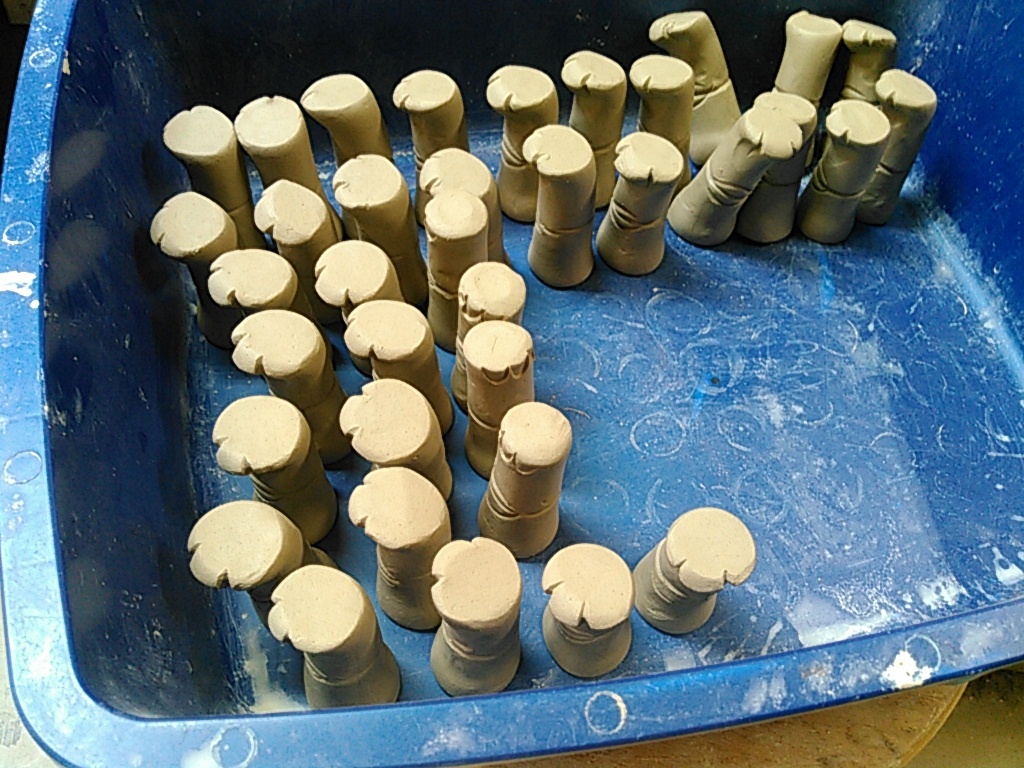
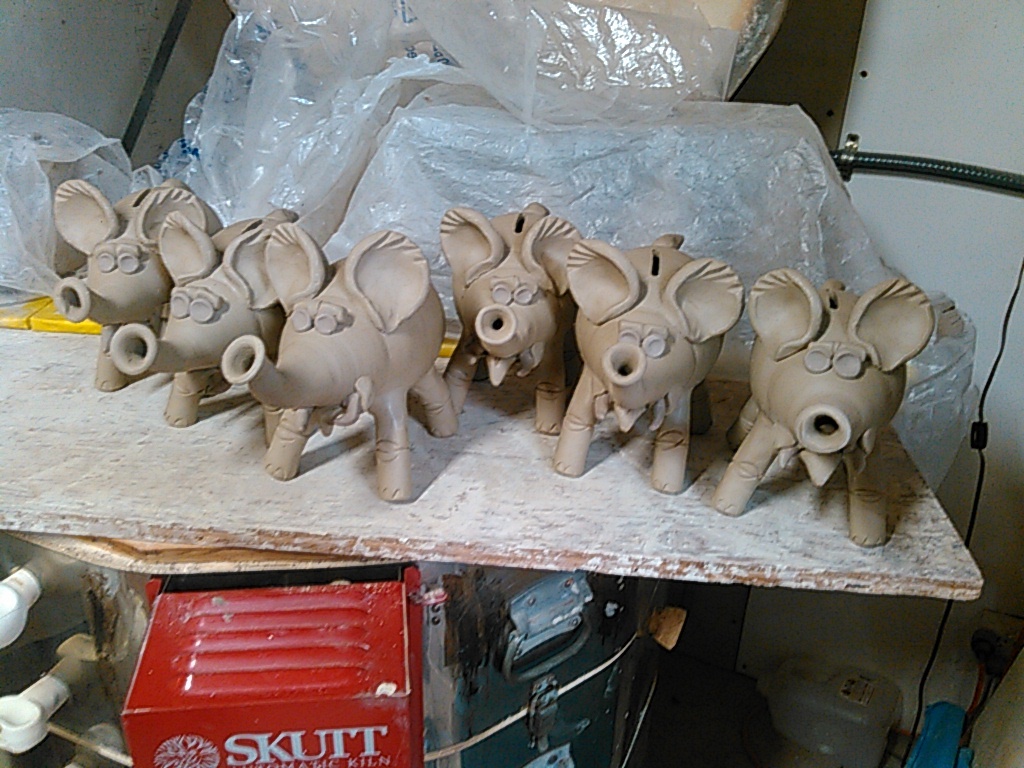
Today, I've slimmed down the bank range to eight styles: pigs, elephants, hen and frog and cat, and three kinds of dinosaurs. I've raised the price--though $40 is probably still too low. But I've simplified some of the designs, and made a lot of specialized tools to help streamline the process of making them. I ran through a lot of pig and chicken banks during the holidays--for people bringing home the bacon, or starting their nest eggs--so that's what I made this week.

Piggy banks take a cork in the mouth to suggest a pig's flat snout. Corks are made in a variety of sizes, and initially, I'd just buy a variety and mix and match. It's a lot easier if I only have to get one consistent size, so I adapted a trick from my contract throwing days. I was making hummingbird feeders, which had to fit a specific size of stopper; Will provided a key-shaped rib to slide into the neck of the bottle to make the perfect width and taper. It was easy enough to size up the idea to a jumbo version, fit for an oversize cork.

While the wheel is turning, I slide the rib down just until the shoulders at the top engage with the lip. Result? A perfect match for a number 38 cork, sourced from the local home-brew supplier.

The chicken banks hide their stopper--or, as I call it to customers, "No penalty withdrawal"--underneath. I originally used a wooden cork there as well, but found rubber stoppers cheaper and less bulky. I still need to indent the bottom so the bank doesn't wobble on its stopper, so after I take them off the wheel, I set them over a bisqued hump mold, then poke a little hole to let some of the air out. This leaves a nice indent where I'll cut a hole the next day, when leather hard.

The bodies are then left uncovered overnight to firm up. I pinch and formed the add-on bits--beaks and tails, ears and feet--sitting on the sofa watching a Dr. Who DVD with Denise (The Runaway Bride, Catherine Tate is hilarious. I can see why they brought her back as a regular companion a year later.)

Tuesday morning, the pigs were still kinda sticky, but I was able to flip them over on their mouths to continue drying while I assemble the chickens. They'll be ready to handle by the time the chickens are finished. I add all the bits first: beak and eyebrow, feet, wing-tips, tail. When it's time to make cuts, I again use specialty tools: a home-made circle cutter that makes a hole that shrinks down perfectly to fit a number ten rubber stopper.

I also get out my dip-pen hole cutter to drill two small holes on the back of the head, which will be connected by knife cuts to form a neat, round-ended coin slot.

Once all the bits and bobs are attached, and the colored porcelain eyes, combs and wattles joined, I leave them uncovered to continue drying while I assemble the pigs.

It takes a solid two days work to make two dozen banks. Fortunately, I don't have to make them all that often.
offcntr: (bunbear)
Denise and I have a long-standing Valentine's tradition; not dinner out (not possible this year), not the heart-shaped chocolate cake (though that one happens more often than not). No, every year on Valentine's Day, we try to do an art project together.

In previous years, we've made paper. Rolled and pressed ceramic tiles. Made mono prints and woodcuts and even took glassblowing lessons.

This year, Denise taught me to make paste paper.

It's one of several decorative paper techniques she learned in her surface design class last winter, along with cyanotype, suminigashi and paper marbling. Cyanotype requires chemicals and sunshine, neither of which we had available, and both suminigashi and marbling require specialized inks and some sort of vat or tray to float your colors.

Paste paper, though, is easy. All you need is a starch-based paste (corn, wheat, rice, or, for the fancy, methyl cellulose), some acrylic colors, and a smooth surface to work on. Everything else can be improvised. There's a pretty good tutorial for the process here.

Denise had the paints and a jar of wheat paste that's been in the fridge since before lockdown, and I found a nice piece of plexiglas in the pottery shed. The rest was plastic spoons, popsicle sticks, yogurt cups, and a cake decorator's plastic scraper that I use to lay mastic when I mount tiles.

You start by mixing your paste with some acrylic paint--the cheaper and runnier, the better. Lay down a piece of drawing paper on the plexiglas and mist lightly with water, then blot up the excess.

Blop down four or more spoonfuls of paste on the paper, then spread with the scraper. Cover the entire sheet, over-running the edges. The plexiglas is easy to clean. You can use different colored pastes and blend them with the blade, or go for simple.

Now make a pattern. Denise is using the serrated edge of the decorator's blade, but you can use a brush, a plastic fork, your fingers. If you're not happy with the pattern, smooth it out and try again, adding a little more paste if necessary.

Pick up the edge of the paper with a knife or the edge of your blade and careful transfer it, holding from beneath, onto a blotter or drying rack. Here we're using all my cookie-cooling racks.


They'll curl up a little as they dry, but once completely dry you can press them flat under a weight, and if you're gluing them onto a book cover or card, that will help straighten them as well.


I found my favorite pieces were actually made with an old, flattened toothbrush, either with a sine wave pattern or the more jagged waves shown above. In both cases, I started at the top and overlapped the layers as I worked my way down.

We only stopped when we ran out of racks; they're stacked up with 2-inch kiln posts to allow air flow.
offcntr: (Default)
Here's a good comparison between too-brown, over-reduced saw-whet owl plate, and one refired to cone 9 in my electric kiln. Not quite as nice as if it had been properly fired in the first place--background glaze is a little murky--but the picture is just so much brighter.

Here's a couple if other fancy birbs out of the same load.

And some serving bowls, also much brighter.

Electric

Feb. 7th, 2021 10:26 am
offcntr: (snoozin')
My electric bill is gonna be so high this month.

I usually do about three electric kiln firings every other month, averaging around 90 kwh per firing. Already this month I've done four cone 9 glaze firings, to remedy the over-reduction in my last gas firing, and I'll probably do at least two more. At 120 kwh apiece, that comes out to... a whole lot of electricity.

But the results are so worth it. Here's the latest batch.

I should see if Georgies carries plate setters--little mini-tables of ceramic refractory that stack atop each other. It would make refiring these guys so much more space-efficient.

Next time, I'm gonna take before and after photos of a refire. Believe me when I say, these look much better!

I have butter dishes again! I completely sold out of them at Holiday Market last year. I've sized them up a little; previously, I'd made them to accommodate the short, fat butter cubes that are more-or-less standard here on the west coast. But customers tell me that organic butter uses the long, skinny sticks more common back east. (And in fact, I bought a couple of pounds in that form at the Grocery Outlet that were from my hometown creamery: Grassland Butter, of Greenwood, Wisconsin!) So these new dishes are still as broad as before, but a good inch longer, to take both styles. If you buy butter in one-pound blocks, though, you're still gonna have to cut them up.
offcntr: (be right back)
One more throwing video, making a covered pitcher perfect for iced tea. This will be the last for a bit; I start glazing Sunday for my August firing, and even if I manage to get some footage of that, it won't get mixed until sometime in August. Meantime, enjoy some hot summer pottering.


(Music by Datri Bean; Sweet Tea and Slow Down Summertime, from her album, Slow Down Summertime/Butter Bean Records.)

Also, I tweaked my trimming video a little, here. Not much, just using the smoother transitions and adding a title card.
offcntr: (radiobear)
I may have gotten... a little ambitious. This video is nearly ten minutes long.

Got an email wanting to order three large batter bowls. I've already made nearly everything I need for my August 2 firing, but figured, Why not? Throw four, just to be sure, I'd still have plenty of time to dry and bisque them in time to glaze. And I'd been reminded, looking for music for my coffee cup/painted mug piece, of another Trout Fishing in America song, 11 Easy Steps, that begins "Still spinning around; lowering my orbit."

But I'd already done a video throwing bowls, another one trimming. What would make this one different?

That's when I thought, What if I record the whole process? Wedging, throwing, extruding coil and pulling handles and trimming?

Reader, I wound up with 11 files of video to edit together. The shortest was 19.2 megabytes; the longest, 946.8. All in all, they totaled 4625.3 Mb, over four-and-a-half Gigs.

It's a good thing I have a very big hard drive on this laptop.

I had to edit in another song to make the soundtrack fit, a medley of 11 Easy Steps and Dream, another Trout song. Discovered a few new tricks in iMovie, like how to cross-dissolve between clips, change the framing, make a title card. I'm damn proud of the result. And maybe a little exhausted. Might not be making any new videos for a little while.

Still spinning around...


(Music by Trout Fishing in America; 11 Easy Steps, from Family Music Party and Dreams from Closer to the Edge, Trout Records)


Cuppa

Jul. 16th, 2020 09:08 am
offcntr: (rocket)
All I want is a proper cup of coffee...


(Music by Trout Fishing in America; What I Want is a Proper Cup of Coffee, from Family Music Party, Trout Records)
offcntr: (live 1)
It seems like all of the pottery videos out there, especially wheel potters like myself, feature throwing. I get it, it's magic. A wet lump of clay, a little water, hands in ballet and presto! A pot appears!

The thing is, that's only part of the process. Before the throwing, there's wedging and weighing the clay (or perhaps even mixing up the clay, or at least recycling the scrap). Afterwards, there's trimming, handling, drying. Loading and unloading kilns. Bisque fire, glazing, decorating, Glaze fire. Sorting and pricing and packing. That's partly why I find it so hard to answer the question, "How long did this take to make?"

Today I thought I'd focus on trimming. I had a couple of dozen toddler bowls at the leather hard stage. (A weird but traditional description, halfway between wet and dry. Think chocolate bar consistency, where you can shave off neat curls with a sharp tool.) I set up the camera again, two different angles (well, three, but one only shows the back of my knuckles) and shot some video.

Traditionally, a pot is turned or trimmed on the wheel, like it's thrown. I put it upside-down on the wheel head, re-center it, and fix it in place. In olden times, this was done by moistening the wheel head, turning the wheel slowly while tapping the pot gently with your right hand. It will, with practice, settle into place in the center, where it can be anchored with three lumps of wet clay.

I hate tapping pots on center. It takes time and patience, and if you tap too hard, it'll slide right off the other side of the wheel. Back about, oh, 1983, I was exposed to a Giffin Grip at a summer workshop in Tuscarora, Nevada. It's a device that clamps onto your wheel head, with rotating top plate and three hands that slide uniformly toward center as you twist it. Quick, neat, easy, fast. I ordered one as soon as I got home, used it until it wore out, about three years ago. At which point, I unboxed the second one I won at Clay Fest 2008 for Best in Show.

Trimming tools come in a variety of forms: spades, blades, ribbons, loops. My favorite is a Bison trimmer, a wedge-shaped blade made of tungsten carbide I paid $50 for at NCECA. It's super hard and tough, though brittle--I have to be very careful not to drop it on the concrete. But it holds its edge well, I've only had it sharpened twice since I bought it in 2006.

So I set up the Grip, put some cardboard around the wheel table to catch scraps, bring a ware board of leather hard pots down. Center one, lock in place, spin. I start from the outside of the foot ring, trimming away and down toward the rim. Afterward, I cut a circle defining the inner edge of the foot, trim out clay. Burnish the inside of the foot with my trimmer, then scribe a quick little spiral. Tweak the profile of the foot, smooth the outside with a medium-hard silicone rib, then dress up the foot with a softer one. Brush off the crumbs, mark it with my stamp, low on the outside, put it back on the board. Repeat.

Like so.


(Music by Rachel Garlin, Spin, from Wink at July/Tactile Records)

You're a human being, not a human doing.
offcntr: (window bear)
I was going over my orders last week, updating my throwing list. Between three orders, I have a total of 42 dinner and dessert plates to make.

That's a lot of flat stuff.

(Music by Greg Brown; Flat Stuff, from River of Song, Smithsonian Folkways)

Old barns full of blue sky; backyards full of junk...

Pachydermy

Jun. 24th, 2020 12:43 pm
offcntr: (chinatown bear)
Back in the studio after several weeks break. I've collected a bunch of special orders, and need to make a replacement sugar bowl for the elephant tea set. Fortunately, I remember that the cream and sugar bowls were a pound of clay each. Throwing them is like making a bank, but in miniature.

It's finally summer here, warm and dry in the studio, so by evening, I can wrap the bodies tightly in plastic for over night. In the morning, I first make parts: pinch pot ears, rolled coil legs and hand-formed eyebrows, tails, lower lips. I scrape some clay off the bottom edge of each body, roll it around on the tabletop, and rib the surface smooth and round.

Next, I score and slip attachment points, put on ears, eyebrows, chin and tail. Flip over and attach the legs.

The hole in the back is cut with the same tool I use for stoppers in the banks. I save the disc cut-out, clean up the edge, and add a coil around the rim. I add a blob of clay for a knob, stick the whole thing to a centered chuck on the wheel, and clean, smooth and shape the knob and lip.

I put some thin plastic over the hole, position the lid, and do any tweaking needed to fit. Afterwards, I take out the plastic and gently replace the lid, so it and the body will dry at the same rate. I make eyes from white and colored porcelain, score and moisten to attach, make pupils with a little bamboo chopstick tool.

offcntr: (live 1)
I often think it would be cool to have a digital video camera, like a GoPro. Show a potter's eye view of the throwing process, how amazing and magical it is to spin a lump of clay into something beautiful and useful. I even looked into buying one--do you know how much they cost? I have friends who set up their cell phone to take video while they work, post it to their Instagram, but I don't have a tripod for my cell, and can't really work one-handed while I hold the phone in the other.

Then I realized, this morning, that I do have a tripod, Denise's (and her father's before her), from when we both had 35 mm cameras. And also, that my Canon digital camera has a tripod mount on it. And it takes video.

I couldn't set up for a potter's-eye view--my throwing stool is backed up tight to the wall, elbow-to-elbow with the ware shelves. But I could set up from the front, and at least show the pot taking form. It's useless for instructional purposes--you can't see what my hands are doing half the time, and besides, I throw left-handed--but for showing the magic? Hell yeah.

I played around with video editing this afternoon, decided to throw in one of my favorite songs as a soundtrack. That's the late Freyda Epstein with her band, Acoustic AttaTude, singing Bill Danoff's Potter's Wheel.

Earth and water and wind conspire/with human hands and love and fire...

Ten lives

May. 9th, 2020 04:34 pm
offcntr: (maggie)
Yesterday was cat bank assembly day. I'd made the bodies Thursday, thrown as closed forms on the wheel. I sketch out faces with my index finger and thumbnail--a great improvement over early days, when I made individual eyes, eyebrows and cheeks--dimple the bottom on a bisque form, and leave them to firm up to leather-hard overnight. Meanwhile, Denise and I flopped on the sofa and watched a Leverage episode on DVD while I made parts.

In the morning, I re-impress the bottom (if the air vent I made the previous day closes, air pressure can flatten it out again) and smooth with a rib.

Next I add the features: score and slip ears, nose and fore paw first, as well as their attachment points. Firmly attach, clean up edges, and repeat for the other three paws.

The tails start as extruded coils--it's just faster and more consistent than rolling them out on the tabletop. I do roll the ends to give a nice taper, and a pointy end. Leave them straight overnight, then curl them into an amusing shape this morning. Score, slip, attach. The last thing to go on is the tongue made of pink-colored porcelain clay. It will brighten up considerably in firing.

The last bit of work is subtractive, not additive. I have a sheet-metal cutter just the right size to punch out a hole for the stopped, under the bottom; because the bottom is dimpled, the pot won't wobble on its cork when it's finished. With my hole punch and fettling knife, I cut a coin slot in the back of the head. Lastly, I stamp my signature chop down next to one of the feet.

Repeat nine more times, and I'm done with cats for the day.

I leave them uncovered overnight, to let them stiffen up. Once they're hard leather-hard, it's safe to put them out in the sun to finish drying.


offcntr: (rainyday)
Today's studio plan: glaze seventeen animal banks, eight incense dragons, and one hundred St. Vincent de Paul bowls.

Thank goodness I had help.

This is my wife, Denise. She's a microbiologist by training, a papermaker and bookbinder by choice. Which means that, while she can't glaze and decorate my painted production pots, she's really good at jobs requiring care and precision. So she can glaze and wax eyes on dinosaur banks. Wax the cut edges and eyes of incense dragons. Clean up the glaze drips as I dip and drain the banks.

As for the bowls, we set up a production line. I waxed feet, poured the insides and dipped rims in my white glaze. As soon as they were dry enough to handle, she carefully dipped the outside in one of six different colored glazes, wiped the bottom across a sponge, and moved them to a stack of ware boards. Periodically, I'd bring out more bowls to glaze, change out the colored glaze tub, and set up another board on the stack.

It took us two hours to glaze the banks and dragons. Barely two more to glaze all the SVdP bowls.
offcntr: (Default)
It's the part that never gets in the pottery videos, not even mine. It's not cool, not sexy, but oh-so-necessary: trimming the bottom of the pot.

I don't do it on everything. Mugs don't get trimmed, nor glasses and tumblers. I also make my plates no-trim, and my bake ware. Bowls though, really need that extra bit of finishing. A chance to lose a little weight off the bottom, get a little lift.

It happens when the pot is leather-hard, halfway to dry. I flip the pot over, recenter it on the wheel, anchor it down. Then, with a sharp tool and a fairly fast wheel, I trim away around the outside, cut down a little on the inside, to form a nice foot ring. Smooth with rubber ribs, stamp with my maker's mark, remove to the ware board. And repeat. Catch as many of the trimmings on the wheel as possible, gather them into the recycle bucket to slake down, dry out, run through the pug mill later. Any that hit the floor go in the trash, as they may be contaminated with dirt, gravel or plaster, none of which are good things to find in your clay body.

Traditionally, the potter puts the bowl down an a clean, damp wheel head, starts spinning, and taps the pot with the heel of the hand, more or less at random, until it shifts to center. Then it's stop the wheel, anchor it down with three lumps of clay, and start trimming.

I was always pants at re-centering. As often as not, I'd knock the pot right off the wheel head, and even when I didn't, I took forever to get it right. So I was fascinated back in 1985 when, at a workshop in Tuscarora, Nevada, I discovered the Giffin Grip.

They had a first generation model, particle board and formica, spiral grooves cut with a router. The plate snapped to the wheel head, and twisting the top made three little hands move inward to center and grip the pot. It wasn't perfect--if the pot was too soft, it would deform; too hard and it might split. But it was fast and efficient, two things budding a production potter was learning to value, and I saved up my money to order my own once I got home.

They'd updated the design by then, using injection molded plastic, water proof and wear resistant. I finally wore mine out this winter, replaced it with the one I won from Clay Fest for Best of Show back in 2005.

Clayhenge

Nov. 11th, 2019 09:05 pm
offcntr: (Default)
I buy my clay a ton at a time, generally four or five times a year. Usually, the clay is well-aged (I can tell because the company stamps the mixing date on the box), ready to use. This last batch, though. I ordered it in mid-August, and the mix date was... August 2019. It was literally a week old.

Now the thing is, clay plasticity (workability) improves with age. Legend has it that Chinese potters used to lay down clay for their grandchildren, stored in a cool, damp cave. I don't know that it's true, but it is true that clay will benefit from some aging, six months would be good, a year maybe better.

It's also the case that a clay manufacturer mixes the stuff up a little on the wet side, assuming that it'll be sitting on a pallet in a warehouse for six months or a year.

This stuff is kinda short (non-plastic) and just super, sticky wet. Throwing it straight out of the bag is like working putty. The only way I can use it at all is if I pull the block out of the plastic, split it in quarters, and leave them uncovered overnight. Or perhaps all day. Maybe two.

Hence, clayhenge. This is fifty pounds; earlier this weekend, I had seventy-five out. Last week, a couple of days, a hundred.

Seven hundred pounds left of the current order. Hopefully, the next batch will be a little better.
offcntr: (live 2)
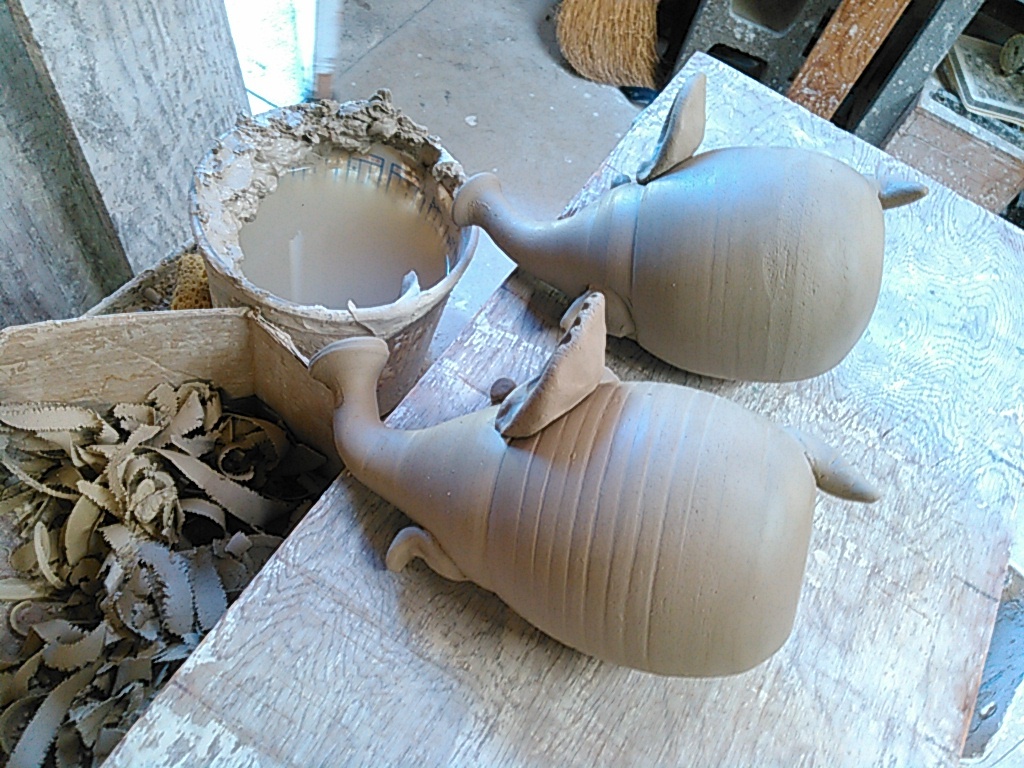
Had a run on elephant banks, the last few weeks, so I decided it was time to rebuild the herd. As usual, I forget to take pics in the initial, messy stages. sigh.


offcntr: (window bear)
Well, it's been three days since I unloaded the test firing. I can finally talk about it without flinching. It was a qualified success.

We reached temperature, top and bottom largely even. We didn't take much more time than usual, and the gas usage was right on average, 34 units.

The reduction was awful.

I've talked it over with Linda, who fires next, suggested some ways to make it better. Reduce the primary air (air through the burners, controlled by opening and closing a threaded shutter), maybe use the peephole in the chimney as a passive damper. Don says you really need to be able to smell the unburned gas, which is way more reduction than I'm used to in the inside kiln. Whatever happens, it's out of my hands now.

The firing wasn't a total disaster. I had lots of white pots in my stuff, little or no copper red in anyone else's. But Nicole's cobalt crawling glaze mugs looked good, Jon's servers and some of his mugs were fine, and Linda said her two mugs and fox vase, while not ideal, were certainly sellable. Don's two test bowls looked normal to me, but Brian got mostly cobalt in his bowls, though there was a little copper red inside two. A couple of my pots, near the top back, showed the opposite effect, over-reduction giving a peachy bloom to my white base glaze. Go figure.

There was one spot of perfect reduction in the entire kiln, on the back left side, just above the bag wall. Just big enough for one pot; guess which one?

Squirrel!

December 2025

S M T W T F S
 123 456
7 8910 1112 13
14151617 18 1920
21 2223 24252627
28293031   

Syndicate

RSS Atom

Most Popular Tags

Style Credit

Expand Cut Tags

No cut tags
Page generated Dec. 25th, 2025 01:21 pm
Powered by Dreamwidth Studios