It sucks

Feb. 16th, 2024 04:21 pm
offcntr: (Default)
I don't often see anything in the Ceramics Monthly suggestions column that's useful. They're either too esoteric or too basic, things I'm never gonna need or things I've long since figured out on my own. This one, though, was perfect.

I'd struggled for years with the best way of glazing big cookie jars and canisters. They're too heavy and awkward for dipping tongs, and if I poured the inside, there was no good way to dip the outside that didn't end up with glaze overlaps that show up as a different color in firing. But some clever potter found an answer.

This is a dent puller. A thing auto body shops use to fix small dents in your fender or side panel. It's a little suction cup that gloms onto your car hard enough to pop out the damage. And it's perfect for suspending a jar or canister for a vertical dip into the glaze bucket.

There are some caveats. You have to pour glaze into the inside first, pour it out, and wipe the rim. You have to keep it perfectly vertical going in to dip the outside, so as not to plop out the air pressure inside the jar. And you need a perfectly smooth surface to latch onto, which means paraffin wax dip, not liquid wax resist. But within those parameters, it works a charm. I moisten the suction cup with a little water before engaging, tug to test the seal before committing to the glaze, and support the jar with my hand on the inside, against the dry inner glaze surface as soon as it's out of the bucket again, in case the suction fails.

Ajar

Jul. 25th, 2022 07:40 pm
offcntr: (Default)
Ceramics Monthly hosts a monthly column for tips and tricks, going back to the beginnings of the magazine. I even got one published, once, explaining how to create a shrinkage ruler by back-calculating shrinkage and photo-enlarging a regular ruler that can be used to measure wet work and tell you how much smaller it will be after firing. (Laminate the enlargement for best results.)

Most of the tips are either obvious, or so specialized that there's no way I can use them in my studio situation. This one, though, I had to try.

Most of my pots are small enough that I can glaze them in a single dip with glazing tongs. With big bowls and bakers, I might use two sets of tongs, one in each hand. Cookie jars, though, are a problem.

They're too big to handle with tongs--a 12-inch jar full of glaze will not come out of the bucket. And if I pour the inside, then dip the outside, I wind up with finger marks either on the rim or the foot, and over-dipping that end leaves glaze overlaps that show up after firing. It was frustrating.

Then I saw this suggestion: Buy a high-powered suction cup, the kind body shops use to pull dents out of cars. Stick it to the bottom of the pot. And dip.

I didn't think it would work, but Harbor Freight had a 2.5" cup for under ten bucks, so I figured What the heck?

First try didn't stick, because I'd used liquid wax resist on the foot, and it wasn't smooth enough to hold a seal. Dipping in hot paraffin fixed the problem, and by moistening the suction cup before applying it, I can dunk the whole outside of the jar in one step. No fingerprints or overlaps, and it even helps reduce glaze drips.

Broke it out again this last week and glazed a bunch of nice cookie jars for the firing.
offcntr: (bella)
My next firing is late July, preparing for a trip to Anacortes in August, so I really should start making pots. Even though it's hot. And I'm also prepping for the show in Roseburg this weekend--have I mentioned I have a show in Roseburg this weekend?

But I have an order for 40 more mugs for Great Harvest Bakery, and this time, they're paying actual cash money (because I still have so much bread credit from the last order).

I was digging through my toolbox and found a wood-block anvil I used to use for coil-building demos in my teaching days. I realized with a little refurbishing, I could use it to make much cleaner impressions from the logo rubber stamp. So I got out my chop saw and belt sander, adjusted the length and fiddled with the curvature, then screwed on a scrap bamboo handle. The result:


A very clean, consistent impression, and much less deformation of the mugs.

Bank Run

Feb. 24th, 2021 11:30 am
offcntr: (rocket)
Midwinter is a good time to catch up on the more complicated items. The studio is consistently cool and damp, and pieces that have a lot of parts to put together can be assembled in a more leisurely fashion, as the pieces don't dry out so quickly. I spent Monday and Tuesday making banks.

At one point in my foolish youth, I had more than two dozen different kinds of animal banks, from pigs to penguins, whales and walruses. I also foolishly priced these high-labor, time-consuming items at a mere twenty bucks.

I really didn't value my time, back in the day.

Today, I've slimmed down the bank range to eight styles: pigs, elephants, hen and frog and cat, and three kinds of dinosaurs. I've raised the price--though $40 is probably still too low. But I've simplified some of the designs, and made a lot of specialized tools to help streamline the process of making them. I ran through a lot of pig and chicken banks during the holidays--for people bringing home the bacon, or starting their nest eggs--so that's what I made this week.

Piggy banks take a cork in the mouth to suggest a pig's flat snout. Corks are made in a variety of sizes, and initially, I'd just buy a variety and mix and match. It's a lot easier if I only have to get one consistent size, so I adapted a trick from my contract throwing days. I was making hummingbird feeders, which had to fit a specific size of stopper; Will provided a key-shaped rib to slide into the neck of the bottle to make the perfect width and taper. It was easy enough to size up the idea to a jumbo version, fit for an oversize cork.

While the wheel is turning, I slide the rib down just until the shoulders at the top engage with the lip. Result? A perfect match for a number 38 cork, sourced from the local home-brew supplier.

The chicken banks hide their stopper--or, as I call it to customers, "No penalty withdrawal"--underneath. I originally used a wooden cork there as well, but found rubber stoppers cheaper and less bulky. I still need to indent the bottom so the bank doesn't wobble on its stopper, so after I take them off the wheel, I set them over a bisqued hump mold, then poke a little hole to let some of the air out. This leaves a nice indent where I'll cut a hole the next day, when leather hard.

The bodies are then left uncovered overnight to firm up. I pinch and formed the add-on bits--beaks and tails, ears and feet--sitting on the sofa watching a Dr. Who DVD with Denise (The Runaway Bride, Catherine Tate is hilarious. I can see why they brought her back as a regular companion a year later.)

Tuesday morning, the pigs were still kinda sticky, but I was able to flip them over on their mouths to continue drying while I assemble the chickens. They'll be ready to handle by the time the chickens are finished. I add all the bits first: beak and eyebrow, feet, wing-tips, tail. When it's time to make cuts, I again use specialty tools: a home-made circle cutter that makes a hole that shrinks down perfectly to fit a number ten rubber stopper.

I also get out my dip-pen hole cutter to drill two small holes on the back of the head, which will be connected by knife cuts to form a neat, round-ended coin slot.

Once all the bits and bobs are attached, and the colored porcelain eyes, combs and wattles joined, I leave them uncovered to continue drying while I assemble the pigs.

It takes a solid two days work to make two dozen banks. Fortunately, I don't have to make them all that often.

This sucks

Nov. 6th, 2020 03:38 pm
offcntr: (Default)
A recent Ceramics Monthly suggestions column featured what looked like a neat trick: Dipping pots in glaze using a suction cup.

Specifically, a high-pressure dealie used by auto body shops to pop out dents on car fenders. This sounded ideal for me, specifically for cookie jars. The medium and large size are too big and heavy to dip in the glaze bucket using tongs (the small ones are even right on the edge of too heavy to wrestle out when they're filled with glaze). So I pour glaze into the pot, swirl around, pour out.

Then I need to dip the outside somehow. (The other option, putting it up on some sort of riser in a pan and pouring glaze over it has never given an even, paintable coat.) I can either grab onto the base, dip in mouth first (trapped air keeps from letting more glaze inside), or grab by the rim and dip foot first into the bucket. Either way, I wind up with a 1-2 inch strip that needs to be dipped later (or big finger-marks that need touch-up). There's glaze overlaps and thin spots, and it's just not good.

But this looked like it might work, allowing me to dip the whole jar in mouth-first, holding on by suction to the waxed base. Harbor Freight had two different sizes, 2.5 and 4.5-inch diameters, for $2.99 and $3.99 respectively. At that price, it was worth a shot.

The 4.5-inch cup was too large, but the 2.5-inch seemed a strong contender. (Fortunately, I'd kept the receipt.)

Results were mixed. I had two small and two medium cookie jars. Suction didn't work at all on bare bisque, of course, too porous. With liquid wax resist to seal up the base, it held a little better. Moistening the rubber before using was better yet. I was able to dip all four jars, but two--one each size--let go coming out of the bucket, and I had to grab them and fix glaze scrapes later.

I'm still optimistic. I dipped another pot in hot paraffin, applied the suction cup. It made a really tight seal. I think the liquid wax coat is just too thin to make a proper smooth surface to seal.
offcntr: (Default)
Assembling teapots for the end of the production run. Sold one at Market recently, which reminded me that I do usually sell a few at the holidays, and I only had three left (four, if you include the oversized one. My normal teapot holds four cups; got a special order for two six-cup models, and have one left over).

The one good thing about working in fall is that nothing dries too fast; the body stays leather hard, the spout doesn't get crispy. I did have to put the lids out in the breeze and sun for an hour, to get them dry enough to trim, but that was just long enough to assemble the rest of the pot.

Note the use of a couple of my favorite tools, below: a hole-maker that's dip pen with the nib reversed, a cheese cutter with the roller removed, used to trim the base of the spout to size and shape, and a paper template dropped in the gallery, allowing me to line up the handle with the spout. Before I learned that trick from Ellen Currans, my handles were always a little wonky.

Once the lids had finally set up, I could pop them in the Giffin Grip, trim them smooth and round, then attach a lump of clay, center it, and throw a knob on top. I've got a little metal tool, about the size and shape of a putty knife blade pulled out of its handle, that I use to form and finish all my knobs. The last step is to drill a little hole in the lid, to allow air in as the tea pours out (otherwise, it'll glurp). Since I want a smaller hole, I use a bit of broken umbrella spine, ground sharp. (What do you call a broken umbrella? Un-brella?)
offcntr: (Default)
Well, that didn't go as planned.

I said yesterday that today, besides handling all the mugs I made, we'd also be blending up yucca leaf pulp for paper-making. Denise had it cooked down and rinsed, and I had, after an afternoon's tinkering, gotten the pulp blender running. (Electric motor brushes were jammed, not making contact with the rotor. Once they were free, it only took me another hour to figure out how to keep them from popping out while I tried to slide the assembly back onto the shaft. Spoiler: it involved bamboo skewers.)

Then we woke up to this.

Note: this photo is not color-accurate. My camera looked at the hellish, tangerine orange sky, said, "That can't be right," and tried to correct it to something more normal, kinda like the first Viking photos from Mars that showed blue sky instead of pink. In any event, between the smoke and the ash sifting down, all outdoor activities were cancelled. (Except for a run down to BiMart Pharmacy--there were only 4 puffs left on my asthma inhaler. I did not ride my bike.)

Kind of a shame, really. I was looking forward to running the beast again. It's a four-gallon recirculating blender, 70% recycled materials from BRING and St. Vincent de Paul, 20% Jerry's, and 10% sweat and improvisation.

I can't say I invented it, more reinterpreted it from a marginal illustration in one of Denise's paper-making books. Scrounged from BRING: a stainless-steel 3/4 hp garbage disposal, heavy-duty grounded electrical cord, and light switch, with box and face-plate. At Vinny's, I found a plastic carafe from a water cooler. Jerry's provided four feet of pool vacuum hose, fir 1x2s and various bits and pieces of plumbing to connect it all together.

What is does: Cooked plant material and a lot of water are put in the carafe, which has had top cut open, bottom cut off to the size of a sink drain. Flip a switch, and the garbage disposal spins up, shredding the contents and spewing them out the hose, which is clipped to the top of the carafe, effectively pumping it through the system again. Keep blending until everything's shredded to a fluffy pulp, and then use the hose to direct it into a fabric-lined basket hanging atop a 5-gallon pail. Wait for the water to drain, bottle up the pulp and you're ready to pull paper.

I've made a bunch of paper-making tools for Denise in the past--all her screens, for example, and a nifty water-expressing press made from plumbing parts and a VW screw jack, also a BRING find--but this is the one I'm proudest of.
offcntr: (live 1)
It seems like all of the pottery videos out there, especially wheel potters like myself, feature throwing. I get it, it's magic. A wet lump of clay, a little water, hands in ballet and presto! A pot appears!

The thing is, that's only part of the process. Before the throwing, there's wedging and weighing the clay (or perhaps even mixing up the clay, or at least recycling the scrap). Afterwards, there's trimming, handling, drying. Loading and unloading kilns. Bisque fire, glazing, decorating, Glaze fire. Sorting and pricing and packing. That's partly why I find it so hard to answer the question, "How long did this take to make?"

Today I thought I'd focus on trimming. I had a couple of dozen toddler bowls at the leather hard stage. (A weird but traditional description, halfway between wet and dry. Think chocolate bar consistency, where you can shave off neat curls with a sharp tool.) I set up the camera again, two different angles (well, three, but one only shows the back of my knuckles) and shot some video.

Traditionally, a pot is turned or trimmed on the wheel, like it's thrown. I put it upside-down on the wheel head, re-center it, and fix it in place. In olden times, this was done by moistening the wheel head, turning the wheel slowly while tapping the pot gently with your right hand. It will, with practice, settle into place in the center, where it can be anchored with three lumps of wet clay.

I hate tapping pots on center. It takes time and patience, and if you tap too hard, it'll slide right off the other side of the wheel. Back about, oh, 1983, I was exposed to a Giffin Grip at a summer workshop in Tuscarora, Nevada. It's a device that clamps onto your wheel head, with rotating top plate and three hands that slide uniformly toward center as you twist it. Quick, neat, easy, fast. I ordered one as soon as I got home, used it until it wore out, about three years ago. At which point, I unboxed the second one I won at Clay Fest 2008 for Best in Show.

Trimming tools come in a variety of forms: spades, blades, ribbons, loops. My favorite is a Bison trimmer, a wedge-shaped blade made of tungsten carbide I paid $50 for at NCECA. It's super hard and tough, though brittle--I have to be very careful not to drop it on the concrete. But it holds its edge well, I've only had it sharpened twice since I bought it in 2006.

So I set up the Grip, put some cardboard around the wheel table to catch scraps, bring a ware board of leather hard pots down. Center one, lock in place, spin. I start from the outside of the foot ring, trimming away and down toward the rim. Afterward, I cut a circle defining the inner edge of the foot, trim out clay. Burnish the inside of the foot with my trimmer, then scribe a quick little spiral. Tweak the profile of the foot, smooth the outside with a medium-hard silicone rib, then dress up the foot with a softer one. Brush off the crumbs, mark it with my stamp, low on the outside, put it back on the board. Repeat.

Like so.


(Music by Rachel Garlin, Spin, from Wink at July/Tactile Records)

You're a human being, not a human doing.

Prepare ye

Apr. 23rd, 2020 05:13 pm
offcntr: (Default)
I've recently taken a special order that should net me a lot of bread. Literally, a lot of bread. I'm making custom coffee mugs for our local Great Harvest Bakery, and being paid in kind.

I've been buying bread there since they first opened a Eugene branch. They're down in south Eugene, conveniently located between downtown (where Saturday Market happens) and Lane Community College (where KLCC used to broadcast from), so for many years, they were a regular Saturday stop, on my way from my radio show back to Market. After KLCC moved their studio downtown (and later, I retired from radio), it was less convenient, but it's still a short hop by car from my studio at Club Mud (or a long, grueling bike ride from my home up on River Road). But I really like their bread: It's dense, tasty (especially their Honey Wheat) and keeps really well. On an average week, we'll go through two loaves, sometimes more.

So last spring, when Gordo the owner caught me on my weekly bread run and asked if I'd be interested in replacing their customer coffee mugs with handmade stoneware, I readily agreed. We talked about designs, and he gave me a mug to take home and measure.

For a job like this, where I'm making a new form, and aiming for at least some consistency, it helps to prepare. I measured the original mug: height, inner diameter, width of foot. Volume (16 oz. up to the brim; probably 12 comfortably full with room for cream and sugar). I record all this information on an index card, and back-calculate shrinkage--with my stoneware, multiplying finished dimension by 113% gets a pretty good estimate of wet-clay size.

Then I made a tool. The little wooden cross you see here is called a tonbo, or dragonfly. I learned about them years ago from an illustrated book on Japanese folk pottery. It's very handy for quick checks of dimension. The vertical stem, up to the crossbar, is the desired height of the pot; the cross-piece is the diameter at the rim. I made mine from a bamboo skewer and popsicle stick. Back when I threw production for Slippery Bank Pottery, I had dozens of them, one for each form. I don't use them as much anymore, as I'm less concerned with identical pots. If I need to match them for a set, I'll just pick the ones that match best, use the rest in my booth. But these are not my regular shapes, and I can't put them in the booth, because they'll also be marked my my second special tool: a Great Harvest Bakery rubber stamp.

Work horse

Apr. 7th, 2020 10:27 am
offcntr: (Default)
I thought I'd do a little research on my sewing machine this morning. I really don't know that much about it, except that it's a sturdy little beast, and it's been getting a workout this last week.

Turns out my machine has a history that's about equal parts chicanery and innovation.

The history of the Nelco involves World War II and a man named Leon Jolson. A Jew, he was interned in a concentration camp in Germany, but because of his mechanical skills, he had more freedom of movement than most, and was able to escape and return to his wife. After the war, they moved to New York, where he began as a broker of sewing machine parts, and eventually got a license to import European sewing machines to the US.

He started the Nelco brand while working for Elna and Necchi sewing machine companies, the former a Swiss maker, the latter Italian. Sometime in the late 50s or early 60s, Japanese products were beginning to be accepted in the American market. He contacted a Japanese manufacturer (history is vague on which one) to have them make sewing machines to import. They were substantially cheaper than the European models, and apparently incorporated some of their innovations (without permission). As a result, Jolson eventually lost his distribution rights to Elna and Necchi, but by then Nelco was booming.

My best guess is that my machine dates to the 1960s. I bought it well-used in 1977 for $25 from the group home where my mother worked, and took it off to college. It's patched multitudes of blue jeans, sewed shop aprons and clothing, shopping bags and bears and hats in the nearly forty years since then, and has only been in the shop twice, once for a cracked bobbin assembly, and again for general tuning and adjusting. It's heavy and sturdy, and the only thing I miss is a free-arm for sewing sleeves and cuffs. The nifty little look-alike box is not actually a sewing kit, but a photo slide carrier that belonged to Denise's dad. (She now stores bookbinding supplies in it.)

The best part about this morning's historical deep dive is the postscript. At the end of the article, there was a video showing a machine almost identical to mine (except it has the fancy automatic four-step buttonhole option). Featuring a sewing-machine aficionado familiar to me.

That's singer-songwriter, bassist and Babes With Axes member TR Kelley.

New tools

Feb. 11th, 2020 11:32 am
offcntr: (Default)
A couple new tools, just for the current project: a fish scaler and a sucker punch!

The scale roller doesn't work as well as I'd hope: scales are too deep, might be better on a bigger fish. On a little mermaid, the imprint is both rough and insufficiently detailed. Oh well, best I can do. The punch works perfectly, though, can make various sizes of sucker depending on how hard it's pushed and how much I rock it about.
offcntr: (Default)
It's the part that never gets in the pottery videos, not even mine. It's not cool, not sexy, but oh-so-necessary: trimming the bottom of the pot.

I don't do it on everything. Mugs don't get trimmed, nor glasses and tumblers. I also make my plates no-trim, and my bake ware. Bowls though, really need that extra bit of finishing. A chance to lose a little weight off the bottom, get a little lift.

It happens when the pot is leather-hard, halfway to dry. I flip the pot over, recenter it on the wheel, anchor it down. Then, with a sharp tool and a fairly fast wheel, I trim away around the outside, cut down a little on the inside, to form a nice foot ring. Smooth with rubber ribs, stamp with my maker's mark, remove to the ware board. And repeat. Catch as many of the trimmings on the wheel as possible, gather them into the recycle bucket to slake down, dry out, run through the pug mill later. Any that hit the floor go in the trash, as they may be contaminated with dirt, gravel or plaster, none of which are good things to find in your clay body.

Traditionally, the potter puts the bowl down an a clean, damp wheel head, starts spinning, and taps the pot with the heel of the hand, more or less at random, until it shifts to center. Then it's stop the wheel, anchor it down with three lumps of clay, and start trimming.

I was always pants at re-centering. As often as not, I'd knock the pot right off the wheel head, and even when I didn't, I took forever to get it right. So I was fascinated back in 1985 when, at a workshop in Tuscarora, Nevada, I discovered the Giffin Grip.

They had a first generation model, particle board and formica, spiral grooves cut with a router. The plate snapped to the wheel head, and twisting the top made three little hands move inward to center and grip the pot. It wasn't perfect--if the pot was too soft, it would deform; too hard and it might split. But it was fast and efficient, two things budding a production potter was learning to value, and I saved up my money to order my own once I got home.

They'd updated the design by then, using injection molded plastic, water proof and wear resistant. I finally wore mine out this winter, replaced it with the one I won from Clay Fest for Best of Show back in 2005.
offcntr: (be right back)
Fortnight, actually. The last two weeks were a helluva thing.

Glazing and firing, of course. That's the time I find myself putting in ten and twelve hour days, stumbling home exhausted, rolling out the next morning and repeating the process. I take pictures when I think of it, always intending to post updates, but when it comes down to it, I'd rather flop on the bed with a book and read myself to sleep. In this case, it was complicated by the fact that I was also completing posters and flyers for Clay Fest, as well as print and online advertising, on a computer that was somewhere way below reliable. More on that tomorrow, maybe...

Meanwhile, a brief reprise of the last couple of weeks. 

I started glazing a week before the Sunday I planned to load the kiln. The potter firing ahead of me was over two weeks late in loading (he'd signed up for Labor Day), so still had every shelf in the kiln room full of his stuff. I worked around it as best as I could, stacking shelves in the hallway by the grinder, carrying them back into my studio (less than ideal; I'm far from the kiln, and would have to bring it all back). He finally loaded up on Tuesday night, which is why I wound up putting in 12-hour days Wednesday and Thursday. 

(He was also scheduled to fire right after me, but cancelled a day or so before my load-in. So I could have taken an extra day or two glazing, except I'd arranged for two of our potters to shadow my firing, helping me load and learning how to fire the big gas kiln. So I was kinda committed to loading on the day we'd agreed on a month earlier.)

Got everything glazed by Friday afternoon, as it happened, so we could do Saturday Market as usual. Denise usually helps me load kilns, but as Linda and Brian were helping instead, she got to take the afternoon off, going to open studio with her book arts group.

I forget how reliant I am on her help. She knows when to bring me something to load, when to wait while I figure out what I need. She's always half a step ahead picking out kiln posts, and she never picks up a pot by the painted side. (Lookin' at you, Brian). But still, we ended up finishing up only a little later than usual, Linda was there that evening to watch me light the burners, and Brian actually showed up at quarter-to-six the next morning to observe body reduction. They both were around much of the day, and the kiln behaved beautifully, dropping cone 10, top and bottom together, at around ten minutes 'til six.

I'm really liking the kiln these days--the last three firings have been really consistent, in time, gas used, and minimal amounts of oxidation. I made up a three-page crib-sheet, including notes on how I prep and load the kiln and a copy of my log for this firing, and emailed it to them both.

All right, some pictures.

The squeeze bottle next to the fawn creamer is my new favorite tool. My frequent neighbor at Market, Cherie Todd, does pots decorated with dozens of dots of glaze; when I was complaining about how hard it is to get consistent spots on a fawn with a brush, she gave me a spare glaze-trailing bottle to try. It works brilliantly, on fawns, woodpeckers, barn owls. Anybody who needs white dots over an oxide or stain wash now goes to the head of my glazing list.

I took a couple of interesting special orders this time; Denise's cousin Diana wanted some stealth wine cups, stemless and opaque so she can take the forbidden fruit to neighborhood picnics. She has feeders on her balcony, so her cups feature frequent visitors: hummingbird, flicker, chickadee and dark-eyed junco. I also got a request for smaller teapot: three cups, instead of my usual four (or occasional six. Denise drinks a lot of tea). I did two, as is my wont, and not only did both turn out beautifully, I actually sold both last Saturday.

But the best part of the glazing week happened Tuesday. Fellow potter MIchiyo and her husband Andrew brought visiting family in for a studio tour. Andrew's family is from Australia, so as I was glazing pie plates, I demo'd a koala in their honor. Which led Andrew to ask if I'd ever done a platypus. I said I'd never had a request for one. Oh, you do requests, do you? Sure, some of my best patterns come from special orders. Which is how I came to paint this little darling later in the week.
plate-ypus. snerk
It's a plate-ypus.

I'll see myself out...

A stretch

Jun. 21st, 2019 09:01 pm
offcntr: (Default)
Packing and shipping today; really glad I sprang for a set of mixed length hook bungie cords. Makes it so much easier to keep boxes on the bike, not the road.

Alignment

Mar. 30th, 2019 09:22 pm
offcntr: (live 1)
I used to have the worst trouble getting handles to line up. On anything that had paired handles--casserole, crock, cookie jar--or even a few that didn't, like batter bowls, I just couldn't get the handles lined up across from each other. I'd eye-ball and mark and attach and pull and two times out of four, the handles were closer together from one direction than the other. Drove me nuts.

Then one year, Local Clay, our Eugene potter's group, sponsored a workshop by Ellen Currans. She's a long-time Oregon potter, founding member of the OPA, and made a lot of two-handled platters, servers, baking dishes. And she had a lovely, simple system for positioning the handles.

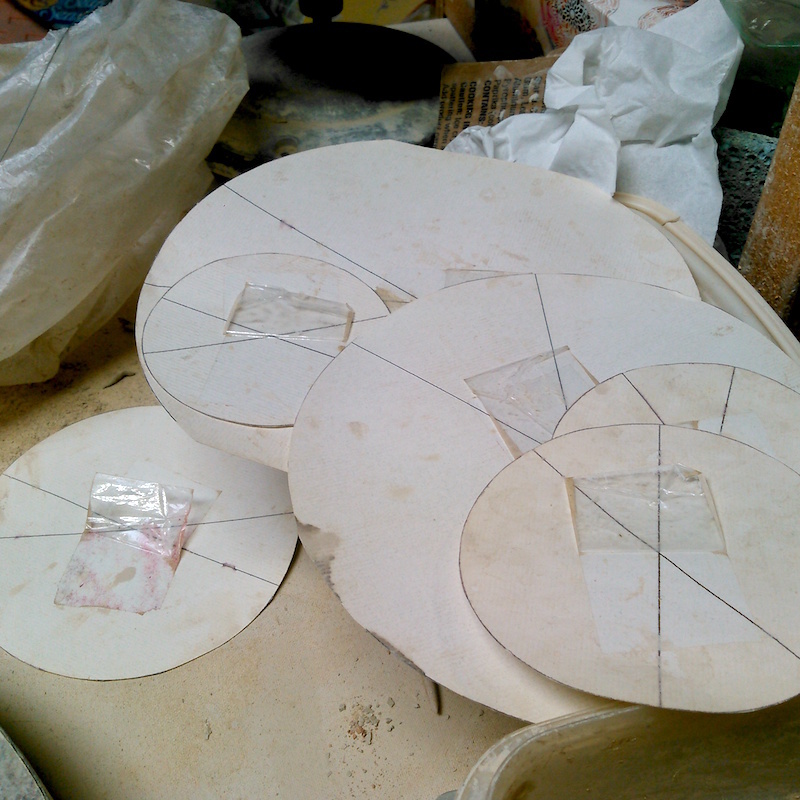
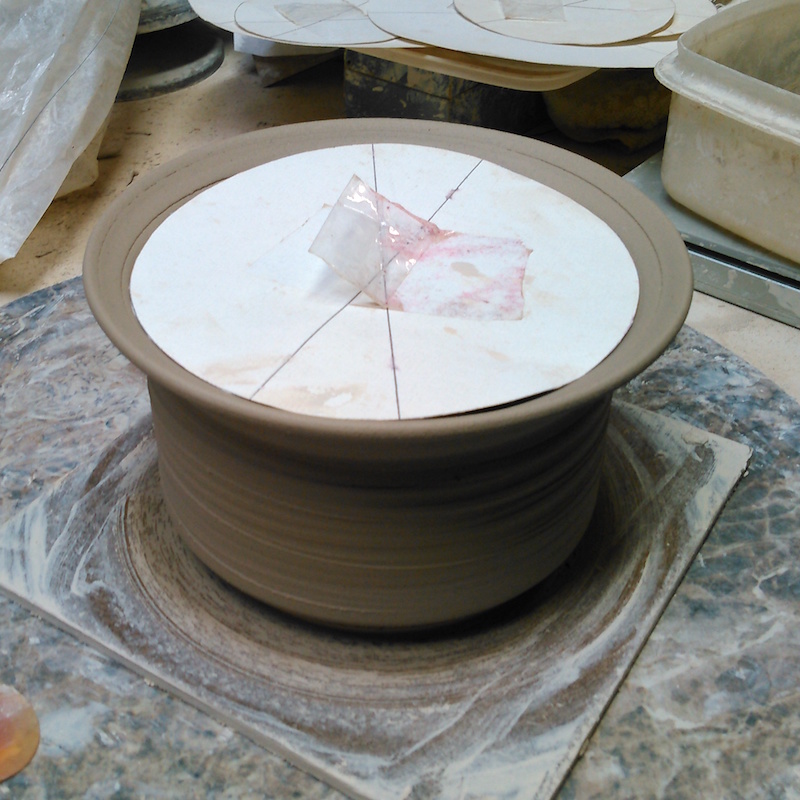
She'd make a paper template the same diameter as the pot, usually by taping the sheet to her potter's wheel and pencilling in the circle, then cutting away the excess. She'd then fold it in half, mark where fold met edge, then flatten it out and refold a couple of inches off the original fold, mark there. Putting the template over the top of the platter or dish made it easy to determine where to place the handles so they'd be exactly opposite one another. Since she was a production potter too, she had dozens of templates in all different sizes, so she always had on to match the next pot. She even made nifty little handles out of scotch tape, to make it easier to lift off the template when done.

I've adopted the system wholesale, taken it a step further: I have templates on the computer that I can size and print onto card stock with the relevant diameters pre-printed. And since I have box tape in the studio, I do the handles as well.

Here's a few of my handle templates, and a small covered crock about to get marked and handled. Honestly, I'm still amazed I never figured this trick out for myself.
offcntr: (vendor)
Many years ago, Saturday Market hired a marketing consultant from Portland to come down and give an off-season presentation at the WOW Hall to us artists about selling our work.

I don't remember more than two points he made (One of which, Don't crowd too much into your booth, I blithely ignore.)

The other point was Don't hide your prices. He said many artists/craftsfolk don't clearly label their prices in the mistaken idea that people will ask them, thus starting a conversation that will eventually lead to a sale. It's more likely, he says, that they'll assume the item is outside of their price range, and walk away rather than being embarrassed by asking about something that they can't afford. Show your prices, he said. Make it easy for them to get past that first hurdle. They're likely to be surprised at how reasonably priced your work is, and be more willing to talk to you about it.

We took this advice to heart, and almost immediately bumped up our sales by a quarter.

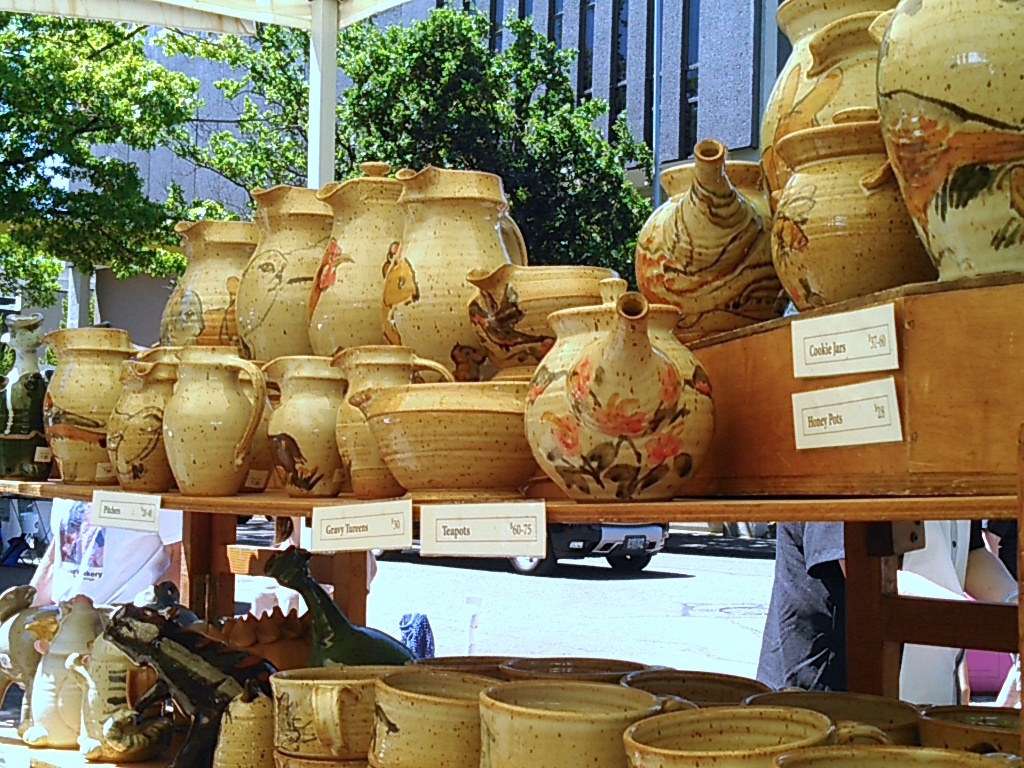
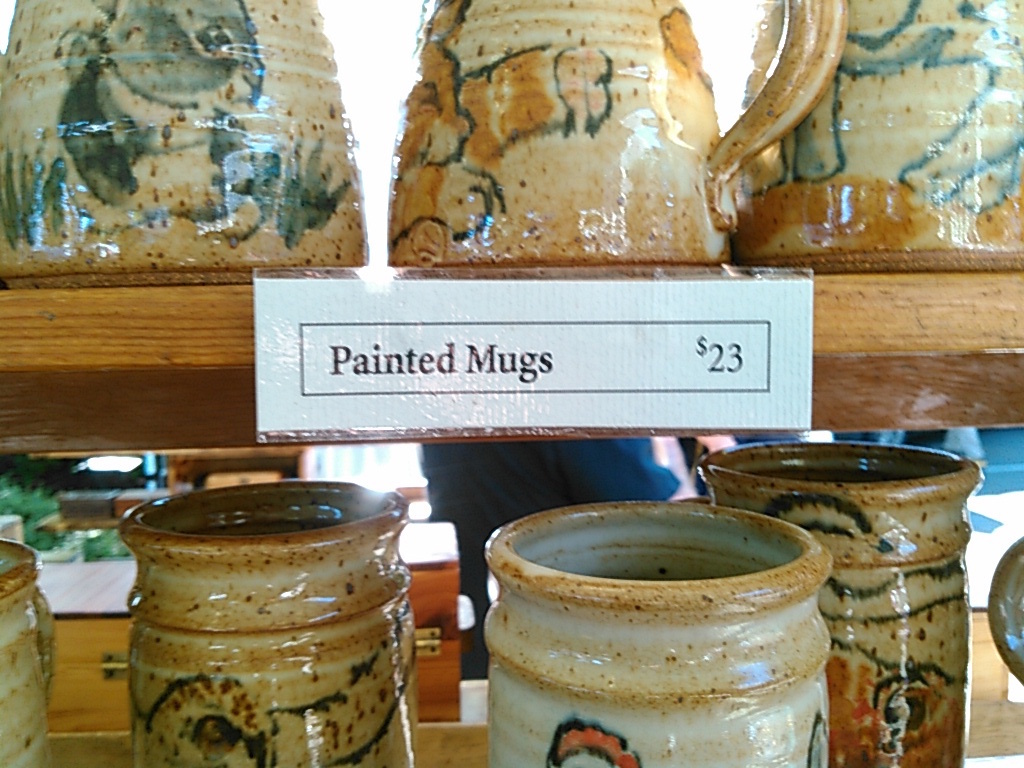
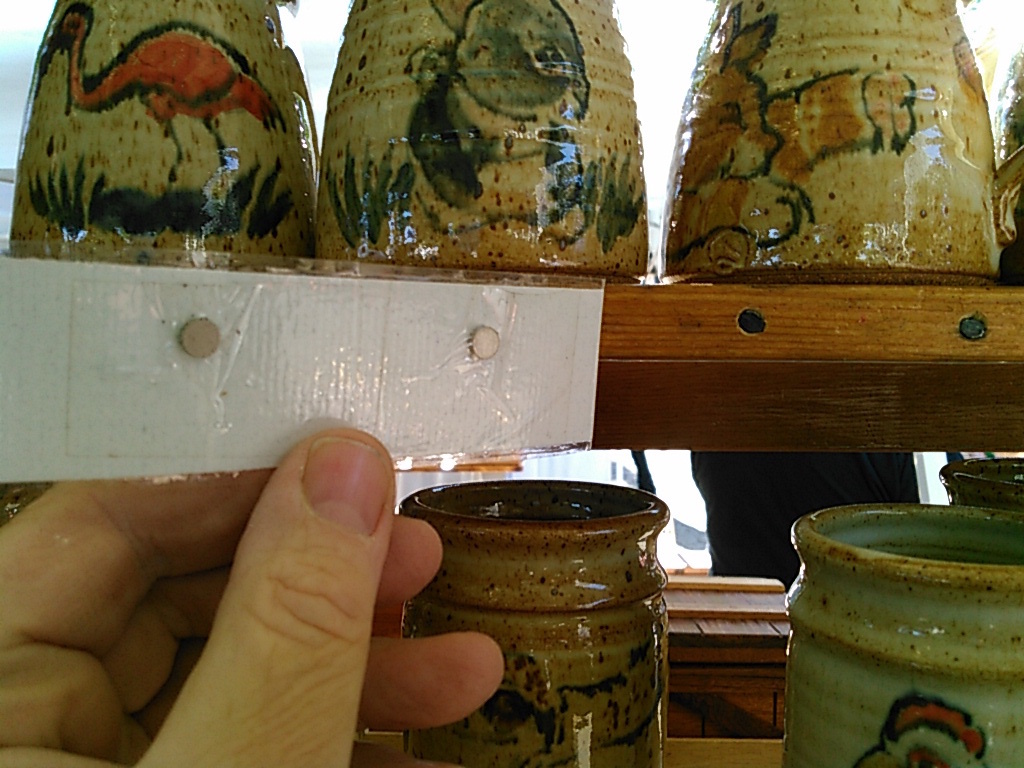
Meet the "shelf talker" (a term I stole from my days at the printing plant, where we made them to show prices for Heileman's Old Style). It's nothing more than a little product-and-price sign, inkjet printed on card stock and laminated with clear box tape. We have at least one for each type of pot on the shelves, two for high quantity items like soup bowls and painted mugs.

For the longest time, we stuck them on with sticky poster putty, which worked great... except in spring and fall, when it was too cold to stick and needed to be peeled off the sign and rubbed vigorously between one's palms. Or in high summer, when it started to melt, leaving sticky traces behind on the shelves at the end of the day.

About a year ago, I had a brainstorm: I found a source online for reasonably cheap rare earth magnets. One or two quarter-inch magnets on the back of each shelf talker and some carpet tacks nailed into the edge of each shelf make setting out the shelf talkers on Saturday mornings literally a snap.
offcntr: (Default)
Bat pins!

Was getting ready to (finally) make mugs this morning when I took a close look at the head of my wheel and saw something surprising: the bat pins were nearly worn away.

I didn't even know this was possible. Bat pins are supposed to be forever, sturdy little bolt heads that hold your throwing bats in place. If anything is supposed to wear out, it's the holes in the bats themselves, particularly the masonite ones. They're always getting loose and wobbly; I've started sticking a sheet of old t-shirt fabric on the wheel head to keep the bats from sliding back and forth.

Well, it turns out the bats weren't entirely at fault. Or maybe they were--the back-and-forth friction, along with the abrasive qualities of the clay, seem to have worn a good sixteenth-inch or more off the pins all the way around, on one pin, all the way to the hollow center of the head. I had to take off the wing nuts, lever out the pins with a vise-grips, and take a set, along with a representative throwing bat, down to the nearest hardware store. (I could have gone to the ceramics supply instead, but only if I wanted to pay four times the price.)

I should have taken a flashlight. Socket-headed machine screws were in the back-most layer of a three-deep sliding hardware thingy. (You know the kind, like sliding closet doors covered with tiny, badly labeled drawers full of every screw and fastener except the one you need right now.)

I finally found what I needed, 3/4 inch pins with a 1/4 inch head. Cost me 86¢ for two. And the best part--almost making up for a lost morning's throwing--is that my bats don't wobble anymore.


Aftermath

Sep. 7th, 2017 09:53 pm
offcntr: (Default)
 I have so many tools to put away.

offcntr: (spacebear)
This is not poop.

It's clay scrap, just pulled out of the recycling bat and ready to pug-mill. Except I don't have time just now, so it's gonna get bagged and set aside until next week, maybe.

I produce a lot of this stuff: wet slop from the throwing bucket, dry scraps from trimming, the occasional broken, cracked or trimmed through piece of greenware. It all goes into four-gallon plastic buckets in front of my wheel where it slakes down to the consistency of, well, poop. Wet cow poop, fresh from spring pasture.

It has some of the smell of poop, too, anaerobic bacteria digesting oil and skin flakes from my hands and traces of organics from the clay. I sometimes wish I'd contacted Mike Rowe back when he was still doing Dirty Jobs. He'd have loved this stuff.

I love it too; I get two or three hundred pounds of recycled clay every time I empty the buckets. After enough time.

Traditional pottery recycling bats are plaster tubs. They're heavy, fragile, but do an excellent job of removing excess water from clay slurry. If you're not in a hurry, though, you can go lighter and easier.

This is my recycling bat: A frame of 2x6" pine, with a mesh bottom: plastic window screen over 1/4 inch galvanized hardware cloth, supported with 1x2" furring strips around (and across) the bottom. The whole thing is mounted on casters, so I can wheel it in and out from under the ware rack.

When it's time to recycle clay, I wheel it out, line it with a thrift-store bed sheet, folded double, and ladle in all the slop. Once it's heaping full, I fold the sheet edges over the top to keep out dirt and bugs and roll it away. Four to six weeks later, (twelve, this time. It was a wet winter) it's ready to come out of the bat and run through the pug mill.

Then back on the wheel. It's the circle of (a potter's) life.

Evolving

Feb. 23rd, 2017 06:56 pm
offcntr: (rocket)
Round about sixteen years ago, when I started making the family room of our new-mortgaged house into a pottery studio, I knew I needed a big shelving unit, something I could slide ware boards of freshly-thrown or trimmed or drying pots on and off of easily. My studio down at Club Mud had a system made of two-by-four uprights and pipe cross-members, simple, flexible and easy to duplicate. Or so I thought.

Almost immediately, I got it wrong.

I put the back set of uprights right against the wall, for stability. Front set about forty-four inches out, nearly to the other end of the four-foot ware boards. Used scaffolding pipe I bought on the cheap from BRING Recycling. It worked. Sort of.

The problem is balance. When you slide a ware board onto the rack, it goes in easily until just past half-way, then the front end starts to droop, more and more the further in it gets. Since the back pipe support was on the back wall, it took superhuman strength to keep the shelf from crashing down on the pots below it before it reached the next support. Clearly, a solution was needed.

At the time, I had a surplus of ware boards. I'd bought a bunch from a potter who was closing shop, so I could just leave a set permanently mounted on the rack, slide the full boards in on top. Sure I lost 3/4" of height on each level, but I could live with that. And it's not like I'd ever run out of boards, right?

Fast forward a few years. Suddenly, I've got three galleries, eight road shows, and Saturday Market is doing unexpectedly well. I'm running out of ware space, I'm running out of ware boards, I have to do something. I briefly consider replacing the base set of boards with something thinner, like 1/4" paneling, but that just seems like a Panda's Thumb solution.

(For those of you who aren't natural history geeks like me, The Panda's Thumb is an essay and book by Stephen Jay Gould that tells how evolution jury-rigs solutions to problems. The panda was a bear that had become strictly herbivorous, and needed the dexterity to strip bamboo shoots from stems so it could concentrate on the high-nutrition bits and toss the chaff. A thumb would be a wonderful help, but unfortunately, the toe that developed into a thumb in primates (and us) was already in use as a toe in the panda's bear feet. Since evolution doesn't go backwards, they evolved a thumb-like appendage from an oversize wrist bone. It works, but it's limited. Kinda like my shelving system.)

Fortunately, I can reverse course. My initial plan was to leave the back uprights in place, for stability, install a new set ten inches back from the front ones, then move them to the back, ten inches from the wall. This would mean no ware board would need support more than 28 inches before the next cross-pipe caught it, and I'd only have to buy hardware and two-by-fours for one more set of uprights.

The more I looked at the existing ones, though, the less I liked the spacing. I'd originally placed holes 5" apart, on center, but never actually used every set, because inch-and-a-half of shelf. With pipes in every other set of holes, my basic space was 10" high. If I only needed one shelf, though, I could use the closer spacing and get twice as many dinner plates, desserts, or pie dishes. With an extra inch, though, I could fit soup bowls. And I throw a lot of soup bowls.

So I went back to Jerry's for two more uprights. Drilled 32 inch-and-a-quarter holes, inhaling copious amounts of sawdust. Installed new uprights, dis-installed old ones, reusing the lag screws. (The photo shows the halfway point. Lighter colored 2x4's are the new set, darker colored ones the old.) Moved pipes into their new places, shifted shelves around, dusted, cleared fifteen years of detritus, and guess what? I have a storage system that works.

Also? Sixteen extra ware boards.

If only I'd done this sixteen years ago.

January 2026

S M T W T F S
     12 3
45678910
11121314151617
18192021222324
25262728293031

Syndicate

RSS Atom

Most Popular Tags

Style Credit

Expand Cut Tags

No cut tags
Page generated Jan. 6th, 2026 01:00 am
Powered by Dreamwidth Studios