Signs of the times
Jul. 21st, 2018 09:48 pm![[personal profile]](https://www.dreamwidth.org/img/silk/identity/user.png) offcntr
offcntrMany years ago, Saturday Market hired a marketing consultant from Portland to come down and give an off-season presentation at the WOW Hall to us artists about selling our work.
I don't remember more than two points he made (One of which, Don't crowd too much into your booth, I blithely ignore.)
The other point was Don't hide your prices. He said many artists/craftsfolk don't clearly label their prices in the mistaken idea that people will ask them, thus starting a conversation that will eventually lead to a sale. It's more likely, he says, that they'll assume the item is outside of their price range, and walk away rather than being embarrassed by asking about something that they can't afford. Show your prices, he said. Make it easy for them to get past that first hurdle. They're likely to be surprised at how reasonably priced your work is, and be more willing to talk to you about it.
We took this advice to heart, and almost immediately bumped up our sales by a quarter.
Meet the "shelf talker" (a term I stole from my days at the printing plant, where we made them to show prices for Heileman's Old Style). It's nothing more than a little product-and-price sign, inkjet printed on card stock and laminated with clear box tape. We have at least one for each type of pot on the shelves, two for high quantity items like soup bowls and painted mugs.
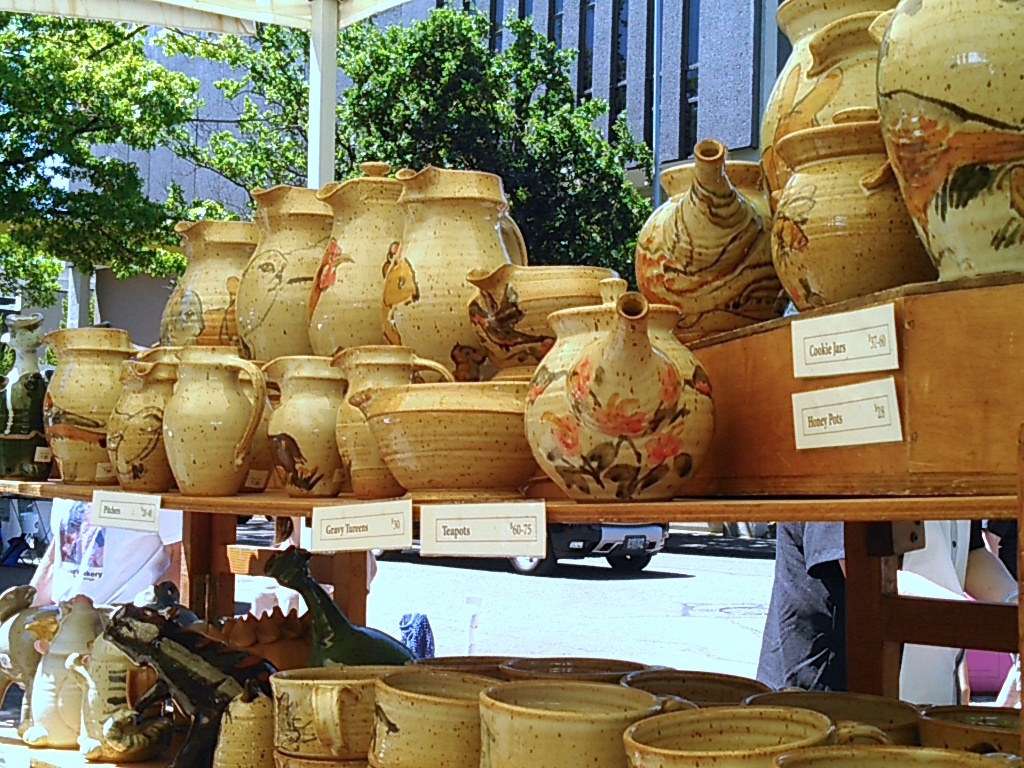
For the longest time, we stuck them on with sticky poster putty, which worked great... except in spring and fall, when it was too cold to stick and needed to be peeled off the sign and rubbed vigorously between one's palms. Or in high summer, when it started to melt, leaving sticky traces behind on the shelves at the end of the day.
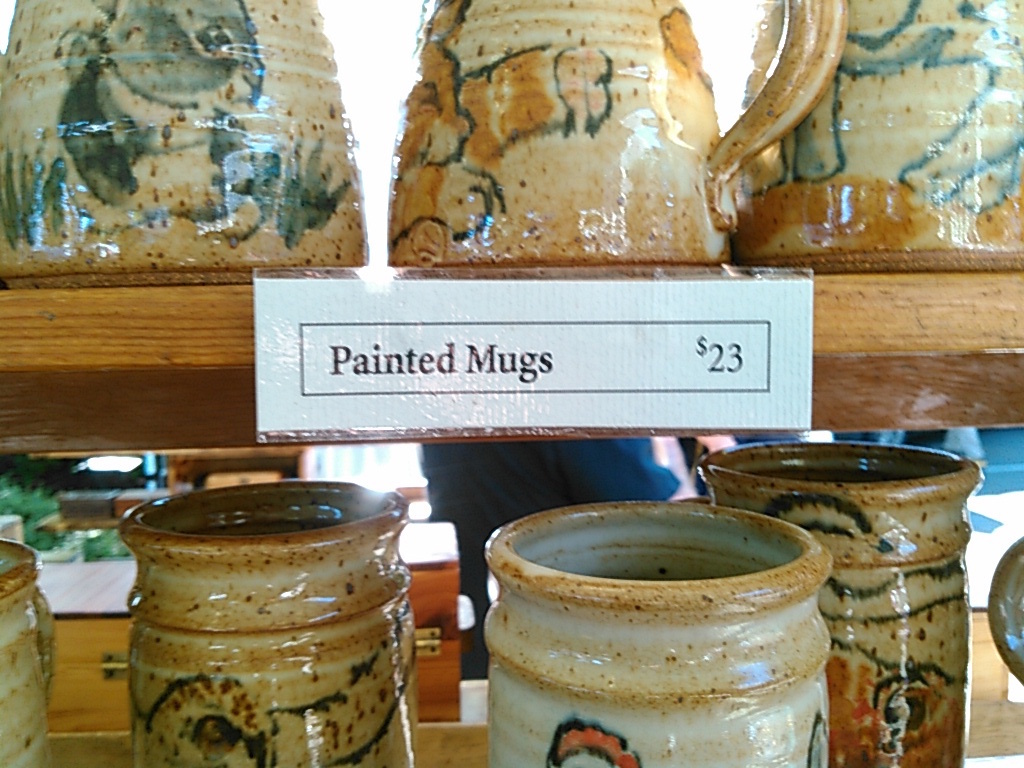
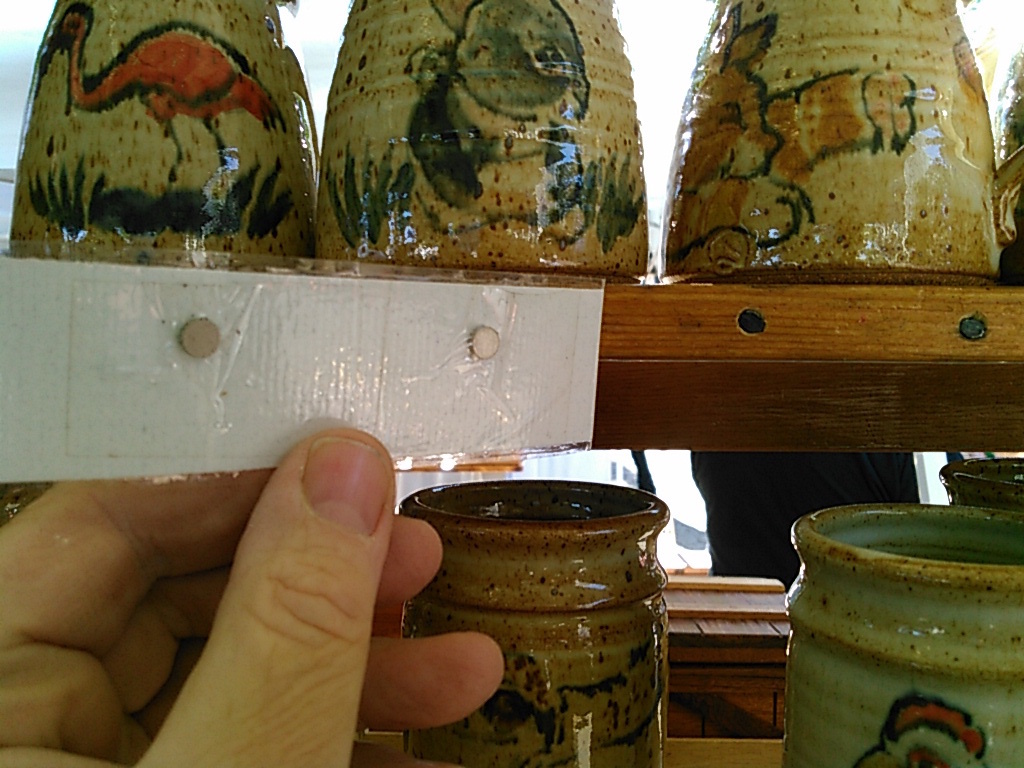
About a year ago, I had a brainstorm: I found a source online for reasonably cheap rare earth magnets. One or two quarter-inch magnets on the back of each shelf talker and some carpet tacks nailed into the edge of each shelf make setting out the shelf talkers on Saturday mornings literally a snap.
I don't remember more than two points he made (One of which, Don't crowd too much into your booth, I blithely ignore.)
The other point was Don't hide your prices. He said many artists/craftsfolk don't clearly label their prices in the mistaken idea that people will ask them, thus starting a conversation that will eventually lead to a sale. It's more likely, he says, that they'll assume the item is outside of their price range, and walk away rather than being embarrassed by asking about something that they can't afford. Show your prices, he said. Make it easy for them to get past that first hurdle. They're likely to be surprised at how reasonably priced your work is, and be more willing to talk to you about it.
We took this advice to heart, and almost immediately bumped up our sales by a quarter.
Meet the "shelf talker" (a term I stole from my days at the printing plant, where we made them to show prices for Heileman's Old Style). It's nothing more than a little product-and-price sign, inkjet printed on card stock and laminated with clear box tape. We have at least one for each type of pot on the shelves, two for high quantity items like soup bowls and painted mugs.
For the longest time, we stuck them on with sticky poster putty, which worked great... except in spring and fall, when it was too cold to stick and needed to be peeled off the sign and rubbed vigorously between one's palms. Or in high summer, when it started to melt, leaving sticky traces behind on the shelves at the end of the day.
About a year ago, I had a brainstorm: I found a source online for reasonably cheap rare earth magnets. One or two quarter-inch magnets on the back of each shelf talker and some carpet tacks nailed into the edge of each shelf make setting out the shelf talkers on Saturday mornings literally a snap.