offcntr: (Default)
The big gas kiln at Club Mud had a problem. Concentrated heat in the fireboxes had baked the softbrick walls to the point where they were cracked, shrunken, or in worst case, curling like potato chips. Pieces were leaning out, blocking the flame path into the kiln, or threatening to fall out entirely. Obviously, something needed to be done.

I budgeted a week for kiln repairs. It took both more and less time than I expected.

I'd actually planned to tackle this earlier, working with Jon, the other potter who fires the kiln regularly. Then COVID set me back a week, and he volunteered to coach high school track in Portland and things got terribly complicated. Fortunately our treasurer, Don, had done a similar project on our previous small gas kiln, and he volunteered to help me out.

I did an estimate on brick needed--nine dozen--and ran up to Hi-Temp in Portland to collect them, just before my quarantine. Now it was time to take the beast apart. We took apart the bag walls--hard brick walls that take the burner flame and deflect it up into the top of the kiln--placing the two sides separately on the kiln car so we'd be able to reassemble them again later. Then it was time to attack the problem.

The walls of the kiln are two bricks deep. Most of the courses are stretchers--laid flat, running parallel to the wall, joins staggered. Every five or six courses, though we had headers--brick laid the short way, running through the wall, tying the inner and outer layers together. Replacing the stretchers was easy. Replacing the headers was like some reverse Jenga: tap the old brick out with a hammer and piece of two-by-four, slide in the new piece, all the while hoping the whole stack doesn't collapse. Then there were complications: the fully-loaded kiln furniture shelf that blocked the first three headers on one side, bricks too tight to shift on the other. We wound up cutting bricks flush and piecing in bits to fill awkward spots. Fortunately, Don is very good at cutting softbrick. I'm not; the saw tends to wander when I try.

It only took us three hours on Monday to do the entire right wall; another three on Tuesday for the left. (We could probably have continued working Monday--it was only 1 pm--but decided tired and stupid wasn't a good idea. I'm glad--the left side was the one with the too-tight bricks. I'm glad we came at it fresh.

Wednesday was a day off--Don had a standing appointment, and we were waiting the the ITC to arrive.

ITC 100 is a high-temperature kiln coating that reflects heat away from the surface it's on. It's amazing stuff--I saw someone make a firebox door for a wood kiln by slathering the stuff on a sheet of plywood. Coating our brick will help prevent it from overheating, cracking and shrinking again. It took two pints, diluted with 50% water (to make three pints total) to cover the entire new firebox surface, with a quarter cup left over.

I did it on Thursday in about an hour, then spent another hour with the shop vac, cleaning up scraps and brick dust. Friday, after everything had dried, I put the bag walls back together, did a little last clean-up, and put the extra bricks away. I'd overestimated, had three dozen left, but there's always need for repairs.

Parallel

Oct. 24th, 2021 08:15 pm
offcntr: (Default)
a *very* good doggyWheel-throwing potters get understandably bored with circles after awhile. They're so easy, and everybody's doing them! Like my colleagues, I fiddled around with breaking the tyranny of the wheel at varying points in my career. Some of my experiments stayed, like squared and oval bakers, and my stick butter dishes.

Others, like parallelogram vases, have fallen along the wayside. But I was recently asked to make one again, a companion to a piece I made years ago commemorating a fellow KLCC dj's doggy, so I had to dust off my thrown-and-altered-pottery skills.

First, you throw a cylinder with no bottom, to the desired height and circumference. Clean up the rim and shape it with your chamois (a thin, soft piece of leather that gets very slippery when wet). Squeeze some water onto the bat, inside and outside of the cylinder, then run your cutting wire underneath, cutting it free and pulling some water with it. This allows you to slide the clay freely across the bat as you reshape the pot. Using the bat pins a guides, run your finger from bottom to top along the inside, creating the first two corners.

Measure an equal distance from each and do it again, creating a parallelogram. Roll out a slab of clay for the base and let both firm up overnight. The next day, score and slip the two pieces together, and cut off the excess bottom slab about half an inch from the side with a wood knife, angling it slightly toward the wall underneath.

Flip the pot over and paddle the slab onto the walls, beveling outward on the edges. Follow with a wet chamois, folding the excess clay in on itself and sealing the join. Flip the pot upright and attach coils to pull to make crock handles.

Dry slowly, to prevent the bits from wanting to crack and separate.

offcntr: (live 2)
I've got two Zoom meetings today, afternoon and evening, and a lot of pots to trim in the studio that just aren't ready yet. So I can't really get anything done there; instead, I convince Denise to come outside and play!

It's iris season here, the two-tone purples are blooming like crazy, the black is budding, the peach just opened it's first flower yesterday. And half a dozen yellow iris, bright as the sun, are scattered around the yard.

Denise has made iris-dyed paper before. The black blossoms, in particular, make a lovely sky blue paper, and the various purples dry green. We've never tried yellow, though. So that's what we decide to do.

Process: Set up a sawhorse table in the sun. Fill a plastic sweater box with water and leave it to warm up. Get out screens, couching cloths (pronounced "cooch-"), various plastic containers, a blender, the press. While I do all this, Denise looks for a jar of mordanted (treated with alum to bind colorants to fibers) white paper pulp. Then I go pick off all the wilted yellow blooms, throw them in the blender with some water, and reduce to a slurry.

After that, it's mix some pulp with a little iris slurry, pour into the screen and swish about. Pull straight up, drain, lay a couching cloth (usually a sheet of Pellon interfacing) down on the paper, press out the water, and transfer the wet sheet to the post (stack of other couched sheets.)

Rinse, repeat.

I also harvested some of the purple blooms and blended them up, did some sheets with both colors of iris, some only yellow or purple. When we run out of pulp, irises or energy, I put the stack of paper sheets into a press to squeeze out the extra water, and Denise transfers them to blotting paper.
offcntr: (rocket)
In the spirit of "before and after," here's a couple of short video clips. First right after I lit the burners, at the start of the firing; the second, as I wait for the last cones to go down. Cone 8 is completely down, cone 9 nearly. Still need the third cone, 10, to drop. (The last cone is a guard cone, to let me know if I've gone too far. At cone 11, the pictures start sliding off the sides of my pots.)


No song this time, just the music of the fire itself.

Coneheads

Aug. 15th, 2020 12:18 pm
offcntr: (Default)
I occurs to me, I talk about what cone I'm firing to regularly on this blog, but have never actually shown you the cones.

Pyrometric cones are devices designed to accurately measure heat work in a kiln. Heat work, the interaction of time and temperature in a firing, is more useful than ambient temperature, which can be measured with a thermocouple and pyrometer. (A thermocouple is usually two different metal wires, twisted together or joined at the tip, that generate an electric current proportional to temperature. A pyrometer takes that current and converts it into a read-out, usually digital these days, calibrated to degrees in your preferred scale.) Because pottery materials respond not just to how hot it is, but how long it's been and how fast the temperature is rising. cones provide much more useful information to the potter than a pyrometer.

The idea goes all the way back to Josiah Wedgwood, back in 1782, who used beads of different compositions to determine how his work was faring in the kiln. Hermann Seger perfected the cone for the Royal Porcelain Factory in Berlin, in 1886. Seger cones are still made today, but most potters us Orton cones, ranged on a standardized scale and manufactured since 1896 by the Edward Orton Company in Columbus, Ohio.

The original Orton cones were numbered from 1 to 14; as low-temperature applications became more common, a new range was added. Rather than using negative numbers, they added a "0" to the beginning of the number. Larger "0" numbers denote lower firings, running from 01 (pron. "Oh-One") down to 022. There is no cone zero.

Lower temperature cones are all brown, from iron oxide in the mix. Because iron oxide is refractory (resists melting) in oxidation, but fluxing (promotes melting) in reduction, they're not super accurate in gas firings, but do well enough for my purposes. For many years, all the other cones were all white, which led to adventures like the time at a summer pottery workshop where the instructor put the cone packs together without his reading glasses. One part of the kiln leapt ahead in temperature, late in the firing, and we fiddled with the damper, air and oil supply until the other part caught up. (We later discovered he'd put both cone 8's in one pack, 9's in the other.) In the last decade or so, Orton has color-coded their cones, though the organic die will burn out in the firing.

I use eight cones in each cone pack, in two rows, pointing opposite directions. The lower temperature cones are closest to the peephole; once they've melted/dropped, I can see the hotter cones behind them. There are two peeps in the door, one about 6 inches from the bottom, the other 10-12 inches from the top. 

My cone packs, in order from low to high, are 08 (when I do body reduction), 04 (check the chimney for flame), 1 (progress), 4 (more for reassurance than anything), 8 (is the kiln firing evenly? Fiddle with the damper!), 9 (fiddle some more!), 10 (that's it, we're done), 11 (oh shit, what happened?). They're boat shaped, with sideboards, because by the time we finally reach cone 10, the lower cones are completely liquid, and we do not want them spilling out onto the shelves.

offcntr: (live 1)
It seems like all of the pottery videos out there, especially wheel potters like myself, feature throwing. I get it, it's magic. A wet lump of clay, a little water, hands in ballet and presto! A pot appears!

The thing is, that's only part of the process. Before the throwing, there's wedging and weighing the clay (or perhaps even mixing up the clay, or at least recycling the scrap). Afterwards, there's trimming, handling, drying. Loading and unloading kilns. Bisque fire, glazing, decorating, Glaze fire. Sorting and pricing and packing. That's partly why I find it so hard to answer the question, "How long did this take to make?"

Today I thought I'd focus on trimming. I had a couple of dozen toddler bowls at the leather hard stage. (A weird but traditional description, halfway between wet and dry. Think chocolate bar consistency, where you can shave off neat curls with a sharp tool.) I set up the camera again, two different angles (well, three, but one only shows the back of my knuckles) and shot some video.

Traditionally, a pot is turned or trimmed on the wheel, like it's thrown. I put it upside-down on the wheel head, re-center it, and fix it in place. In olden times, this was done by moistening the wheel head, turning the wheel slowly while tapping the pot gently with your right hand. It will, with practice, settle into place in the center, where it can be anchored with three lumps of wet clay.

I hate tapping pots on center. It takes time and patience, and if you tap too hard, it'll slide right off the other side of the wheel. Back about, oh, 1983, I was exposed to a Giffin Grip at a summer workshop in Tuscarora, Nevada. It's a device that clamps onto your wheel head, with rotating top plate and three hands that slide uniformly toward center as you twist it. Quick, neat, easy, fast. I ordered one as soon as I got home, used it until it wore out, about three years ago. At which point, I unboxed the second one I won at Clay Fest 2008 for Best in Show.

Trimming tools come in a variety of forms: spades, blades, ribbons, loops. My favorite is a Bison trimmer, a wedge-shaped blade made of tungsten carbide I paid $50 for at NCECA. It's super hard and tough, though brittle--I have to be very careful not to drop it on the concrete. But it holds its edge well, I've only had it sharpened twice since I bought it in 2006.

So I set up the Grip, put some cardboard around the wheel table to catch scraps, bring a ware board of leather hard pots down. Center one, lock in place, spin. I start from the outside of the foot ring, trimming away and down toward the rim. Afterward, I cut a circle defining the inner edge of the foot, trim out clay. Burnish the inside of the foot with my trimmer, then scribe a quick little spiral. Tweak the profile of the foot, smooth the outside with a medium-hard silicone rib, then dress up the foot with a softer one. Brush off the crumbs, mark it with my stamp, low on the outside, put it back on the board. Repeat.

Like so.


(Music by Rachel Garlin, Spin, from Wink at July/Tactile Records)

You're a human being, not a human doing.
offcntr: (Default)
My last two firings were a struggle. The kiln didn't want to heat evenly, and when I did finally get the cones to drop more-or-less together, I had horrible amounts of oxidation. Around the door, along the sides, pretty much everywhere but the very top. So this time, I decided to try a different tactic. Rather than adjusting the airflow via the chimney and damper, I'd cut it off at the source.

A venturi gas burner uses the pressure of the natural gas flowing through it to draw in air through the back of the burner into the mixer, where it (duh!) mixes with the gas, then ignites at the tip of the burner, shooting flame into the kiln. This is primary air, and you can adjust it by turning a rotating shutter at the back of the burner. Secondary air comes in around the burner (or through leaks in the kiln door or walls), drawn by the draft of the chimney. With the big gas kiln, we normally set the primary air early in the firing and leave it, doing any later adjustments with secondary air and draft. But I'd been using less and less gas the last few firings, and it occurred to me that I might have in fact had too little gas in the burners for the amount of air I'd entrained. So this time, when I set the shutters at the start of the firing, opened them only two turns, rather than my usual two-and-a-half.

It wound up being a struggle. The top still got ahead of the bottom in temperature, and I still had to mess with the damper to even it out. The firing took about three hours longer than usual, and about 5 units more gas. But for the first time in ages, I had a glaze firing that wasn't a mess of oxidation.

It was a mess of over-reduction, instead.

The pots were much browner than I like. Some were still passable; others, you could barely make out the pattern. Fortunately, I have a solution.

A few months back, Mason Stains stopped making my preferred black, and the replacement tended to blister when it went on too thick. I eventually solved the problem by changing the ratio of stain to Gerstley Borate (1:2, rather than 1:1), but in the meantime, I had pots with bubbles and blisters. I tried grinding them down, and dabbing on a little Gerstley, and refiring, but while the bubbles would be fixed, the background glaze got browner, and on vertical surfaces, mugs, for instance, the picture would start to slide. What I really needed, I decided, was the ability to fire cooler, in oxidation, maybe cone 9?

Then I discovered (by blowing circuit breakers) that my new kiln was in fact, a professional model, rated for up to cone 10. So I tried refiring some blistery pots, and not only did they smooth out nicely, several of them brightened up considerably. It's still not perfect--the background glaze looks a little dirty, to me--but it's a huge improvement. And it only costs around five or six bucks per firing. So far, I've done two loads of brown pots, and I think I'll do at least one more. Here's a before and after comparison.

I wish I had a solution for the opposite direction.

Rainbows

May. 16th, 2020 10:41 am
offcntr: (snoozin')
Things are kinda monochrome in the studio at the moment, shades of grey and, well, grey. So I thought I'd go outside for a bit, enjoy the brief patch of sun between showers, and show off one of Denise's obsessions.

Irises.

The first set of irises we had were pale purple, brought from our old duplex on Eighth place and planted around the fence and studio door. They still soldier on valiantly, blooming super early. (They're already mostly gone.) Then we salvaged some two-tone purple rhizomes from a garden clean-up at Club Mud, and planted them along the sidewalk.

Where they took over. We've got about ten yards of them now, flowering vigorously, indifferent to weather, crowding, fertilization or lack thereof. They're really bullet-proof, and, honestly? Kinda invasive. I know now why Linda pulled them out at Club Mud. But they make a nice visual barrier for our otherwise wide open front yard.

After that, I started buy Denise roots at the Farmer's Market. A lovely peach, which did not survive. A yellow, that may have? Or these may be from a gift from another vendor. And a black that changed everything.

This being Oregon, we'll frequently find a bud, just on the verge of opening, neatly clipped off by slugs or snails. We usually bring it in, trim the stem, and put it in a bud vase, of which we have several. This particular vase was porcelain, with a crackle glaze. As the bud went to opening to open to wilting down, the juices seeped into the crackle and stained it a super dark blue. Always on the lookout for natural dyestuffs, Denise popped the liquefying blossom into a jar of mordanted (treated with chemicals to help bind colors) paper pulp, and, sure enough, got some lovely sky blue paper as a result.

She has tried every color of iris we have, since then. Most give some shade of green or goldy-brown, and only one particular strain of black iris gives the sky blue. We went up to Schreiners Iris Gardens last May to see the sights, and brought home four or five new varieties, all blooming right now. We'll see what they do in the vat.


offcntr: (Default)
I've been keeping firing logs forever; if I dig far enough into my filing cabinet, I can probably find logs from my Craft Center days, possibly even graduate school. They're a good way to keep track of how often I fire, how much gas I use, what firing strategies. Sometimes they're even useful in predicting what I should do next time.
Sometimes.

Our big gas kiln is weirdly unpredictable. I don't just mean the oxidation spot, which seems to move around from firing to firing. Firing strategies that work for months, even years, will suddenly crash, for no perceptible reason. For the longest time, I had a schedule that fired reliably at eight hours overnight pre-heating, twelve to thirteen hours more the next day to reach cone 10, with the kiln about half a cone hotter on the bottom. I could shut down at cone 10/9.5 and rely on heat rising to drop that last half cone on top on carry-over.

Jon couldn't match my experience. No matter what he tried, even if he tried the exact same settings (possible after I installed gas gauges on all the burners), he'd always fire hot on top, cooler bottom. I privately felt a bit smug, thinking I had a better handle on firing this kiln than he did.

And then, about six months ago, it abruptly switched on me as well. The bottom was staying as much as two cones cooler than the top, necessitating a lot of fussing with the damper, trying to slow down the top long enough for the bottom to catch up, wasting time, wasting gas.

This is where the logbook comes in handy: trouble-shooting. I have a record of a series of attempts, what helped, what didn't. What to try next time. I record the times of adjustments, gas, primary air, damper. Pyrometer reading, and notes on what I'm trying to accomplish at any given point.

Gas pressure is read on gauges on the individual burners, as mentioned. There are valves on each burner, plus a big emergency shut-off valve where the pipe comes in from the meter, in case we have to shut off everything at once. Pressure is measured in water-column inches; I generally pre-heat overnight at 1.6", then turn up to 2" (or more recently, 1.8") for the day's firing. For now, I keep pressure the same at all burners, though I suppose I wouldn't have to.

Primary air is the air going directly into the burners. Speeding gas pulls in air via the venturi effect. The amount of air is effected by the constricted shape of the burner, the speed/pressure of the gas, and the size of the opening permitting in the air. We can't control the first--burners are cast iron--and already talked about the second, above. The third is controlled by a disk-shaped cover, threaded over the gas pipe at the back of the venturi. By spinning the disk, you can move it closer or further from the opening, changing the amount of primary air. I generally fire with the air open 2 turns overnight, move it to 2.5 in the morning when I turn on the gas.

Secondary air is what comes in around the burners, through the burner ports, peepholes, gaps in the brick. Hot gases in rising in the chimney create draft, which pulls in this secondary air. By opening and closing the damper, a piece of kiln shelf that slides in and out of a slot in the chimney, we control the cross-section of flue, and hence the secondary air. Body reduction and the neutral-to-reducing atmosphere later in the firing are generally controlled with the damper.

Londonderry Air is something else entirely.

The pyrometer is a digital read-out attached to a bi-metallic thermocouple that's slid into a ceramic sleeve, protruding into the kiln. Heat from the kiln causes a current in the metals that's then converted into temperature in degrees Fahrenheit or Celsius. It's not actually that accurate, which is why we use pyrometric cones we can watch through the peepholes to determine when we've hit temperature. However, the pyrometer, like an instant-read thermometer in cooking, can give us a snapshot of the firing, tell us whether we're still gaining heat or have stalled. Like the time, it can also be a handy reference when you're comparing different firings.

My notes are usually things like "cone 08 is down, start body reduction" or "tweak the damper for flames in the chimney" (a way to gauge kiln atmosphere), and occasionally "why won't the bottom heat up, dammit!" Descriptions of what's happening, as the other columns give the when and why.

Flame on!

Dec. 10th, 2018 03:45 pm
offcntr: (Default)
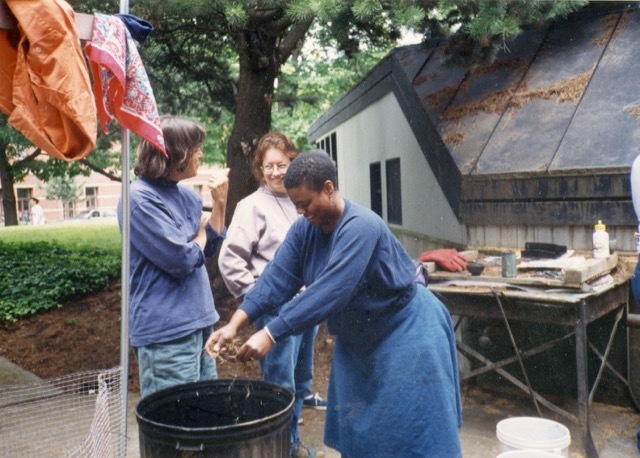
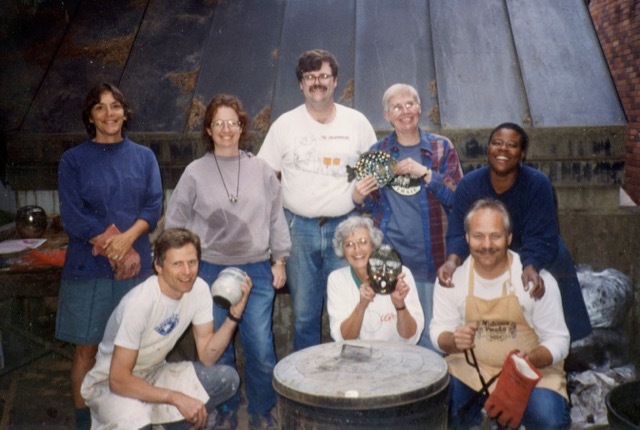
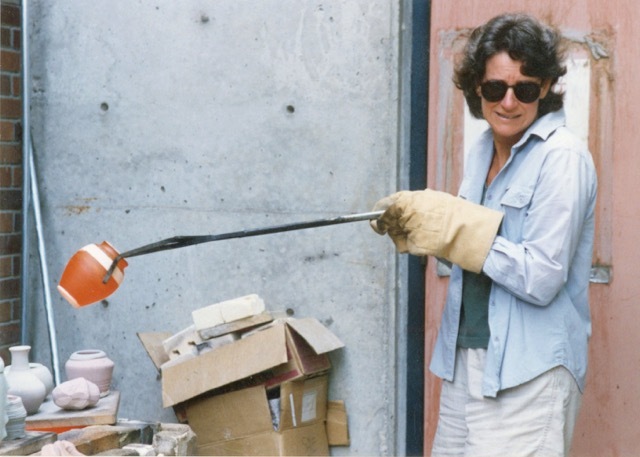
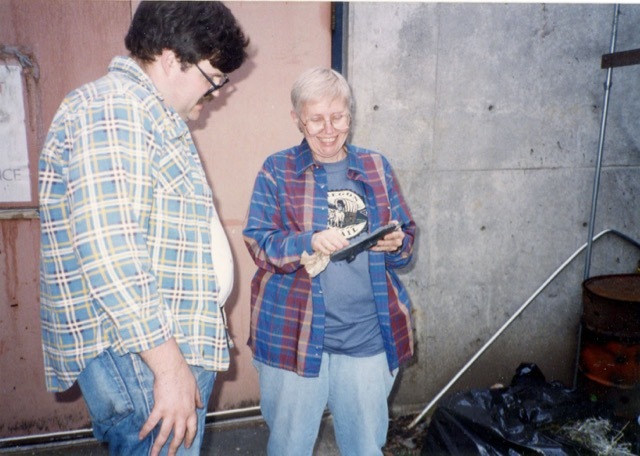
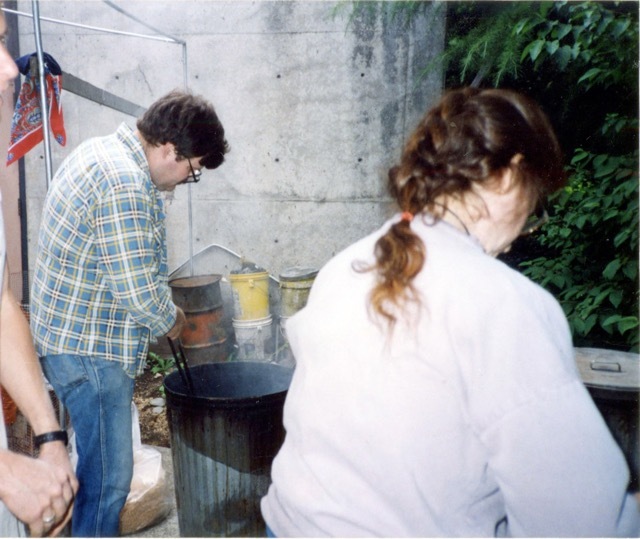
More pictures from the storage unit: A raku class I taught at the EMU Craft Center sometime in the early 90s. I'm actually still in touch with three of the folks shown here; two more, sadly, are no longer among the living. And at least two I have no recollection of whatever. Hey, I've inhaled a lot of (sawdust) smoke over the years. The brain cells get dusty.

Raku is a ceramic process originating in Japan, where low-fire pots were rapidly brought to temperature in very small, wood-fired kilns, then pulled out red-hot and plunged in water to cool. Raku tea bowls were highly prized for the tea ceremony, and the firings eventually became a social event, where pots were provided for guests to show off their calligraphy on. They were then fired on the spot, and much admired before being taken home as party favors.

American raku usually uses a gas kiln, and adds an extra step: After removing from the kiln, and before cooling, the pots are sealed in a metal barrel with sawdust, leaves, newspaper or other combustible material. (A steel trash can with tight-fitting lid works well.) This post-firing reduction emphasizes crackle in the glaze surface, as carbon is absorbed there. Carbon absorption makes unglazed clay surfaces black as well. And it's also possible to get metallic lusters, mostly from copper, and rainbow-hued matte glazes (also copper) as well.

Credit goes to Denise for taking the pictures. I think I just gave her my camera and told her to be careful not to set it on fire.

On the left, Penny McAvoy bravely pulls a glowing pot from the kiln; Kathy Lee scrubs a layer of ash off a plate to reveal the black figure, wax-resist-on-crackle-glaze pattern beneath.

Kathleen Fitzgerald and I pull still-not-very-cool pots from the reduction chambers, while TK McDonald prepares for the next batch of hot pottery.
everybody has something to be proud of


Definitive

Mar. 10th, 2018 08:52 pm
offcntr: (window bear)
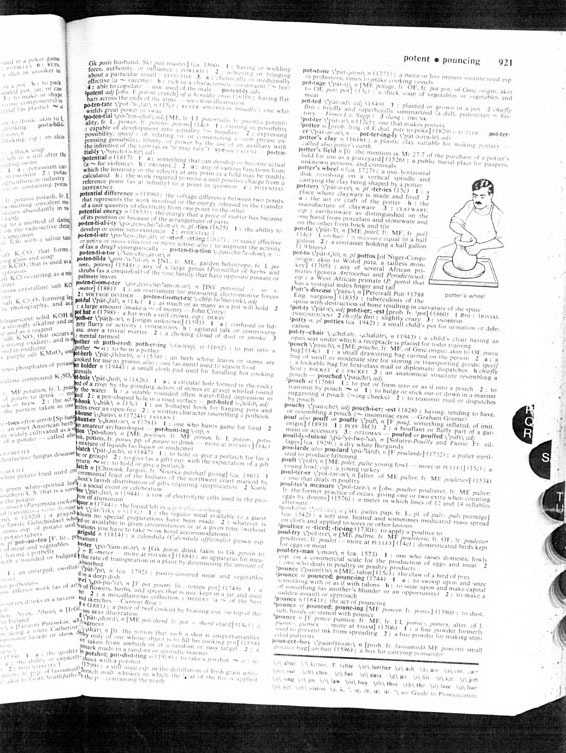
I'm currently reading Word by Word: The Secret Life of Dictionaries, by Kory Stamper, and was inspired to go digging through my files for a photocopy of a dictionary page my friend Lyda sent me many years ago. Here it is:

Let's take a closer look, shall we?

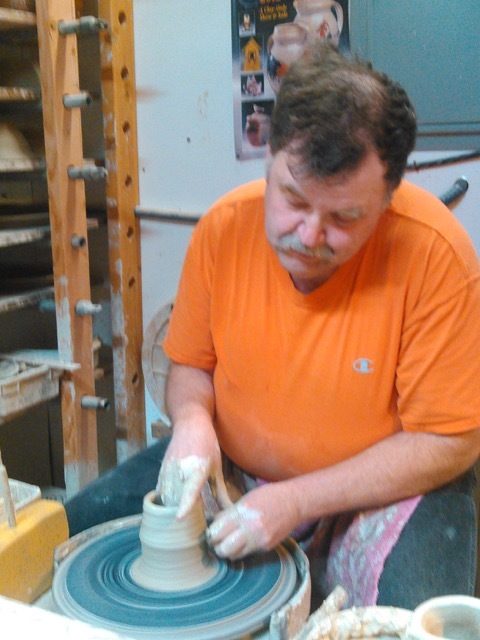
You see the resemblance, of course. It was even more pronounced 20 years ago, when I still had all my hair (and a nifty potter's apron). The clincher? He's throwing left-handed.

I am the very definition of potter...

offcntr: (Default)
It's been a while since I've added any new glossary terms, so here's one:

Pin-holing. A glaze defect leaving small pits, sometimes sharp-edged, in the glaze surface. In stiffer glazes, like my white base, this can be caused by small irregularities in the clay underneath, if the glaze doesn't flow to fill them. In other glazes, particularly those with a high titanium content (Woo's Blue, for instance), pinholes form when gas bubbles burst from the molten glaze but don't smooth over again. These guys can be very sharp-edged.
offcntr: (spacebear)
I've been struggling for a while with the firing atmosphere in my glaze kiln. My glazes need to fire in a reducing atmosphere for best results: creamy color, iron speckles, best oxide and stain color reaction.

The problem was getting the atmosphere consistent. There was always an oxidizing spot, usually low and toward the front left, near the door jamb. I assumed an air leak through the door, around the frame, or even through gaps in the floor, but no amount of tightening brick or packing/wadding with ceramic fiber made any difference.

Then one day a couple of months back, while unblocking the burner ports prior to unloading a particularly unsuccessful firing, it occurred to me that the gas pipe along the wall supporting the burners was not actually parallel to the wall of the kiln. The tip of the front burner was actually a good two inches further from the burner port than the back one. Light bulb time!

As I've explained before, you get a reducing atmosphere in the kiln by controlling the ratio of air to fuel in the kiln. Too much air, oxidizing; too little air, reducing. But there's two different sources of air in the kiln, and two ways to control it.

Primary air is pulled through the burners themselves, by the low pressure caused by fast-moving gas coming out of the aperture into the mixer. (This is the venturi effect, so we call them venturi burners.) A disk threaded onto the back of the burner limits the amount of air drawn into the kiln. Twisting the shutter open allows more air, closed, less.

Secondary air comes in through the burner ports, mostly, but also through the peep holes, cracks in the door, gaps in the floor, what have you. The draft from hot gases exiting up the chimney pulls secondary air into the kiln, where it combines with unburned fuel from the burners. The amount of secondary air is controlled by the damper, a kiln shelf that slides in and out of a slot in the chimney. Close the damper, the kiln reduces. Open it up and the atmosphere becomes neutral or even oxidizing, as the excess fuel is burned more thoroughly.

The problem is, while it's possible to control primary air at the individual burners, secondary air has only one control for the whole kiln. Normally, this isn't a problem, as the gaps and openings are evenly distributed around the kiln, but here I had a burner with a lot more space around it for secondary air. And it happened to be in the corner of the kiln where oxidation was a persistent problem.

But how to fix it? The gas pipe is old, joints solid with rust at this point, so moving one end closer to the kiln would be a major project. I tried just wedging a piece of 2-by-4 between the burner and wall to push it closer, but it didn't move appreciably. I could try to compensate by cutting back the primary air, or even by running extra gas through that burner, but how much is difficult to estimate.

So the only thing left is to move the kiln wall closer.

No, not really. What I did is take some thin sections of soft brick, each about an inch thick, and build a collar around the burner port, closing the gap between burner tip and brick.

My first firing after the changes was astonishing. The lower corner was reduced perfectly. There were a few random oxidation spots, both about chest high. One was in the middle of the back wall, the other at the left door jamb, but they were very small, affecting about half a pot each.

The second firing, which I unloaded last night, was perfect. No oxidation anywhere in the kiln, and no over-reduction (which causes excessively brown pots, and sometimes bubbling in the black and green stains). And the cones? Even, top and bottom, to within millimeters.

I've shown the fix to Jon and Beth, two of the other potters who fire this kiln, and explained my repair. I'm not sure how long it will be before I load high-value items (teapots, special orders) into what used to be the death zone. Maybe one more firing? I need to convince myself that this thing is in fact repeatable.
offcntr: (spacebear)
There are some ceramic processes that require flat sheets of clay: tile-making, certain press-molds, slab building. There's lots of ways to produce flat clay. You can cut slabs from a block of clay with wire and a couple strips of plywood. You can throw it against the tabletop at the correct angle and stretch out your slabs. You can even commandeer your grandma's rolling pin, if you promise to get it really clean afterward.

This is a slab roller. It's a sort of mechanized rolling pin for producing flat sheets--slabs--of clay. Actually, it's two rolling pins, rigged with crank (not seen, off the right edge), gear and chain to counter-rotate and pull the clay--sandwiched between sheets of canvas, to prevent sticking--through the rollers and out onto the table on the other side. There's a set screw on each end of the top roller, to adjust the thickness of the slab to be rolled. If you're rolling from very thick to very thin, you'll do it in steps, rolling a slab, lowering the top roller, running it through again. Anyone who's made their own pasta will recognize the procedure. You'll also need to periodically rotate, flip or change the canvas, as it'll start to stick to the clay if it gets too wet.

I used to do a lot of slab-built sculpture, for which the slab-roller was hugely helpful. Lately, I use it mostly for oval platter bottoms and tile projects, though I still hope to get back into sculpting sometime this winter.
offcntr: (berto)
Saggar. An enclosed vessel used in firing to contain a specialized atmosphere and the pots within it. A saggar can be as small as a covered jar or large as a brick box, chinked with clay and topped with kiln shelves.

Saggars were originally used in Chinese pottery to protect delicate celadon glazes from the ravages of wood ash. Entire chambers of the kiln would be stacked with ceramic boxes, each forming the lid of the one beneath it. Common peasant ware would be stacked around them, unprotected from the ash deposits and drips we so cherish now days.

In Europe, where they used sulfurous coal as a kiln fuel, saggar firing developed into the Muffle kiln where the entire stacking chamber was sealed off, isolated from the corrosive flame.

In modern times, with clean gas or electric firing kilns, we've reversed the purpose. Saggars contain dirty firing atmospheres within our clean kilns. Pots are nested in sawdust or charcoal, draped with seaweed or salt-soaked straw. Bits of copper wire or steel wool are strewn on top. Marvelous, atmospheric effects can be achieved at low temperatures.

In high-fire, saggars are often used to salt or soda fire in a kiln not normally devoted to that purpose. You have to be careful how much you use, though. A friend of mine in my Craft Center days tried a saggar full of salted peanut shells, and the resultant foamy mass of salt-and-ash glaze rose up and engulfed his poor little pot.

Salt fire, soda fire. At sufficiently high temperatures, sodium-bearing materials like salt, soda ash or baking soda will decompose into sodium vapor, a flux that will combine with silica on the surface of the pots to form a glaze. Clay color, amount of soda deposition, variations in kiln atmosphere and flame direction all will influence the color and texture of the glaze in unpredictable ways. Salt is the more traditional material, but urban kilns where a chlorine smell might be offensive favor a soda ash/sodium bicarbonate mix. (There are also glaze variations from the materials that I don't plan to get into.)

Because the soda is in the kiln atmosphere, it also deposits on brick, shelves and posts, with the result that a kiln once used for soda is always and ever after a soda kiln. Soda is corrosive to soft brick, so hard brick is generally preferred for the hot face on soda kilns.

Wadding. Left to its own devices, soda vapor would weld pots to the kiln shelf. To prevent this, ware is stilted on small wads of friable (crumbly), soda resistant material. The mix may include clay, alumina, fine grog, calcium carbonate, sawdust, flour or other material. Wads are usually applied wet while loading the kiln, though some potters dry them and glue them onto the pot beforehand. After firing, they're crumbled away.
offcntr: (vendor)
As I think I mentioned, I ran into a bunch of former students of mine at the Corvallis Fall Festival. This isn't surprising, after all. I taught for 10 years at the UO Craft Center, three or four classes a term, up to ten students per class or workshop. That adds up to enough subjects to form their own statistical universe, though the sample bias is probably extreme.

I frequently get asked whether I'll be teaching again. The long answer involves best use of my time, available workspace, energy levels, relative remuneration; the short answer? Probably not.

One of the folks from Corvallis asked about the Ceramic Whistles class I used to teach. We made ocarinas--eight note whistles--in a couple of styles, in either one or two three-hour session. I haven't made a whistle in years, but did remember where I'd filed the class handouts, so I was able to scan them and clean them up. Emailed them to Tina, and also to Renae, another Craft Center resident potter who's now teaching in Portland, and gets asked about ocarinas (ocarinae?) regularly.

And I thought I'd share them here as well. Picture one is for Andean-style ocarinas; two and three for European. Click to embiggen.

Banding

Sep. 9th, 2015 10:36 pm
offcntr: (rocket)
Got a head-start on glazing for my Fall Festival/Clay Fest firing on Sunday, doing incense dragons and kitty banks. I'm down to one of the latter, so will have many going in this load, some with cobalt blue stripes, others, like this one, rutile gold.


By the way the device it's sitting on is a banding wheel. It's a little fingertip-driven turning device to spin your pot while you paint bands or stripes of color. I also use it to paint the cobalt lines on my French butter dishes, but mostly to apply wax resist to the bottoms of bowls and plates.
offcntr: (spacebear)
Time for more terms:

1227. Designates an electric kiln with twelve sides, 27 inches high. Technically it's a model number for a Skutt brand kiln, but potters use it (and the smaller 1027) interchangeably on different brands. My bisque kiln at home is manufactured by Cress, but it's a 1227 regardless of its actual model number.

Kiln rings. For ease of shipping, repair or expansion, most ten and twelve-sided kilns are made of modules, each two bricks high, nine inches, with two elements in each, sharing a control box and switch. You can expand your kiln by removing the lid and stacking on another ring if you need more space, say for large sculptures.

Blank ring. A kiln ring with no elements or switch, usually only one brick high. Used to expand a kiln temporarily to fire something a little too big for the standard size. We've got a 2.25" blank ring at Club Mud for the smaller, 1027 electric kilns.

Element channel. Groove cut into the soft brick to hold a kiln element.

Elements. Long coils of high temperature alloy wire that glow at high voltages--think giant toaster. They're custom wound to fit a particular kiln, with crimps built in at each corner, and a doubled lead at each end that runs through the wall out into the control box. Because they have to provide more heat to compensate for loss through lid or floor, the top and bottom elements are wound with more coils than the center four elements on our kiln.

Element pins. Lengths of high-temperature wire used to hold elements down in their channel. Standard ones are straight, but you can also buy hook-end or staples, which are handy when working around damaged bricks.

Oxide coat. A protective coat of metallic oxide that forms over elements during firing. Repeated firings, particularly with a reducing atmosphere, say carbonates from clay, or smoke from burning out paper in a sculpture, will damage the coat. It will reform again, but leave less element underneath. Eventually the diameter of the element will be enough smaller to affect the resistance and the firing time and efficiency.

Resistance. To electric current. Too little and the elements won't generate heat. Too much and either the current can't get through (again, no heat) or the element overheats and melts.

Crimp or barrel connector. A metal tube that slides over the end of the element wire and the power lead and is crimped (compressed with a pliers-like tool) in place to make an electrical connection.
offcntr: (spacebear)
Time for some definitions again?

Hot face. The inside surface of the kiln wall or door. (Cold face is obviously the outside.) Because brick expands and contracts with heating and cooling, these will tend move away from each other unless tied together by brick set to connect the two.

Kiln brick comes in several varieties, also shapes. For this job, we only used standard straight brick, 4.5 x 9 x 2.5".

Hard brick. A dense, high alumina heat-resistant brick. Very good in high-stress environments, like the flame channel (in front of the burners), bag wall or chimney flue. Not generally used for an entire kiln, because it absorbs too much heat, so uses more fuel to fire. Exceptions are wood or salt kilns, wh6ere the kiln atmosphere is corrosive to soft brick.

Soft brick. Also known as insulating firebrick. Heat resistant brick that's been formulated to be porous by mixing in sawdust or diatomaceous earth. Because it's riddled with air pockets, it absorbs less heat, so a soft brick kiln is more fuel efficient. Soft brick is rated by temperature: K23 is recommended to fire to 2300° F., K26… you get the idea. Technically, cone 10 is a little over K23, but not by much, so we still use them in stoneware kilns.

Kaowool. Ceramic fiber insulation, an offshoot of the space program. It's what's underneath the tiles on the space shuttle, a thick, white layer like slightly crunchy cotton. Incredibly fuel efficient, but nasty to work with, as the fibers become fragile with too much heat, get airborne, and are very bad to breathe. There are ways to make a kiln of this stuff, but at Club Mud, we reserve it for extra insulation on the cold face, over the arch, for example, or to pack into gaps.

Sairset. A brand of high-temperature kiln cement. We've used it to repair broken bricks in the electric kilns, and to attach brick to the steel top lintel of the stoneware kiln door.

Bag wall. A structure to redirect flame. Ours deflects flame from the burners upward to curve under the arch, through the pots and out through a channel in the floor of the kiln. Without a bag wall, the flame would hit directly only on the bottom pots, and the top of the kiln would be consistently cold.

Vocabulous

Feb. 4th, 2015 05:22 pm
offcntr: (bella)
Been awhile since I talked terms…

Greenware. Green as in fresh, new, not as in color. This is just unfired pottery, generally used when the work is dry, e.g. "I just loaded a batch of greenware into the kiln." Oddly enough, the painted ceramics world uses it to describe bisqued ware. I had to explain this one a zillion times, back when I was teaching.

#1 Pottery Plaster. The best quality, most uniform plaster for making molds. Better than Molding Plaster and much better than Plaster of Paris.

Cottle. The walls of a mold into which you'll pour plaster. For a small mold, you can use a thick slab of clay, well stuck to the base board. Larger forms will be contained by boards, clamped together at the corners, well-sealed with clay or plasticene coils at the base and seams, and liberally coated with a mold release.

Mold release. A substance that keeps plaster from sticking to the piece being molded, the bottom of the mold or the cottles. Typically Murphy's Oil Soap, or an aerosol mold spray. For quick-and-dirty projects, WD-40 or kitchen pan spray will work. If you're making a single mold from a wet-clay original with clay slab cottles, don't bother with any of this stuff. Just peel the clay out when the plaster is set.

Slip mold, press mold. Different ways of using plaster molds. A slip mold is poured full of specially formulated, deflocculated (don't ask. I'll explain some other day) liquid clay slip. After a set period of time, during which the plaster absorbs water through the inner surface of the mold, the excess is poured out and the remaining shell of clay is allowed to harden before it's removed from the mold.

Press molds require less chemistry. Plastic clay is pressed into the mold with fingers, a sand-bag, sometimes a rubber mallet. Excess clay is trimmed away, and the piece is allowed to set until the surface has been dried by the plaster until it is no longer sticky, then removed.

Sprig. A low-relief decorative element on a pot. Usually made with a small press mold. The mold is pressed full, extra clay is removed with a wire, and the mold is positioned over a scored/slipped spot on the pot. Moderate pressure attaches the sprig, at which point the mold is removed and filled for the next sprig.

December 2025

S M T W T F S
 123 456
7 8910 1112 13
14151617 18 1920
21 2223 24252627
28293031   

Syndicate

RSS Atom

Most Popular Tags

Style Credit

Expand Cut Tags

No cut tags
Page generated Dec. 29th, 2025 04:35 am
Powered by Dreamwidth Studios