offcntr: (Default)
The big gas kiln at Club Mud had a problem. Concentrated heat in the fireboxes had baked the softbrick walls to the point where they were cracked, shrunken, or in worst case, curling like potato chips. Pieces were leaning out, blocking the flame path into the kiln, or threatening to fall out entirely. Obviously, something needed to be done.

I budgeted a week for kiln repairs. It took both more and less time than I expected.

I'd actually planned to tackle this earlier, working with Jon, the other potter who fires the kiln regularly. Then COVID set me back a week, and he volunteered to coach high school track in Portland and things got terribly complicated. Fortunately our treasurer, Don, had done a similar project on our previous small gas kiln, and he volunteered to help me out.

I did an estimate on brick needed--nine dozen--and ran up to Hi-Temp in Portland to collect them, just before my quarantine. Now it was time to take the beast apart. We took apart the bag walls--hard brick walls that take the burner flame and deflect it up into the top of the kiln--placing the two sides separately on the kiln car so we'd be able to reassemble them again later. Then it was time to attack the problem.

The walls of the kiln are two bricks deep. Most of the courses are stretchers--laid flat, running parallel to the wall, joins staggered. Every five or six courses, though we had headers--brick laid the short way, running through the wall, tying the inner and outer layers together. Replacing the stretchers was easy. Replacing the headers was like some reverse Jenga: tap the old brick out with a hammer and piece of two-by-four, slide in the new piece, all the while hoping the whole stack doesn't collapse. Then there were complications: the fully-loaded kiln furniture shelf that blocked the first three headers on one side, bricks too tight to shift on the other. We wound up cutting bricks flush and piecing in bits to fill awkward spots. Fortunately, Don is very good at cutting softbrick. I'm not; the saw tends to wander when I try.

It only took us three hours on Monday to do the entire right wall; another three on Tuesday for the left. (We could probably have continued working Monday--it was only 1 pm--but decided tired and stupid wasn't a good idea. I'm glad--the left side was the one with the too-tight bricks. I'm glad we came at it fresh.

Wednesday was a day off--Don had a standing appointment, and we were waiting the the ITC to arrive.

ITC 100 is a high-temperature kiln coating that reflects heat away from the surface it's on. It's amazing stuff--I saw someone make a firebox door for a wood kiln by slathering the stuff on a sheet of plywood. Coating our brick will help prevent it from overheating, cracking and shrinking again. It took two pints, diluted with 50% water (to make three pints total) to cover the entire new firebox surface, with a quarter cup left over.

I did it on Thursday in about an hour, then spent another hour with the shop vac, cleaning up scraps and brick dust. Friday, after everything had dried, I put the bag walls back together, did a little last clean-up, and put the extra bricks away. I'd overestimated, had three dozen left, but there's always need for repairs.
offcntr: (window bear)
One of my favorite Ann Reed songs from back in my radio days was a fast-paced ditty listing all the things going on in the songwriter's life. I don't remember the lyrics in detail, but the hook has stayed with me: "More complications to a simple life!"

It me.

So the plan was, I'd finish Holiday Market, take a few days for Christmas. Pack and ship presents to family in the midwest. Spend a week relaxing and reading and eating cookies, then head back into the studio at the point when my hands couldn't stay away from the clay any longer.

I was going to take it easy, limit myself to 50 lbs. throwing a day, spend three weeks on wet work, throwing and trimming, instead of the two that I raced through before the Holidays, then a long week glazing. Fire on the first of February.

It mostly worked? I mean, I also had to recycle 400 lbs. of clay, before it got too dry, but that means I had 400 lbs. more clay, right? And the extra three special orders that popped up on email were fine, I was gonna throw pasta bowls and dessert plates and little tiny toddler mugs... well, one outta three ain't bad.

But I finally got everything done, trimmed the last three dozen soup bowls last Friday morning, so I could run errands in the afternoon, buy bread... and Great Harvest Bakery was down to nine mugs (out of the 45 I took them in December). So I came home and used up the last of my recycled clay making two dozen mugs to carry them over to my next firing in April. It's fine, right?

Then the kiln blew a circuit breaker while firing Friday afternoon. I caught it before we'd lost too much heat, reset, restarted and it continued to completion. But the following firing blew the breaker twice, and that was the firing that had the ball clay I had to calcine to mix glaze because I ran out last month and only made two buckets, which weren't enough for this glaze run so I needed to mix more. And I got an email from someone wanting to pick up some stew mugs for her daughter-in-law's birthday and could she get six? (Including one in a pattern I'd run out of at Holiday Market.)

I've been getting very little sleep lately.

But things are slowly getting better. I went over the trouble-shooting flow chart at the Skutt Kilns website, and talked to one of their support techs, and we both concluded that it wasn't the kiln (whew!) but might well be the breaker, which is frustrating, because it's only been... oh lord, five years? since I got my kiln and had to rewire the studio with a heavier-duty breaker. Still, it's an easy fix, requiring only two trips for parts (Jerry's didn't have 80 amp breakers, only 70 and 90, so I had to drive down to Garfield Street to get the one I needed. Had it back together by lunchtime, left Denise to keep an eye on it while I went and glazed pots, staying until almost 8 pm to catch up on forty tall mugs.

The firing went fine, as did today's follow-up, so I guess it was the breaker. And I took the van to the studio, mixed up a 10,000-gram batch of glaze this morning, and pulled out stew mugs while the glaze was slaking, just in time for my customer. I didn't get that much glazing done--32 stew mugs and the last batter bowl--but I'm hoping once tomorrow's Club Mud meeting is over, the complications will slack off a bit and I can just paint pots for a few days.

Pictures tomorrow, I promise.

offcntr: (bella)
For once, nobody else is firing at the same time we are, so I finally get to use the shiny new kiln shelves. Almost a full layer of Great Harvest mugs--needed only a few batter bowls to fill out the shelf--and lots of octopodes. Started around 10 am, and had a full kiln car, with about six ware boards-full left over, by 4:30 pm.

Wired

Jun. 11th, 2021 04:13 pm
offcntr: (Default)
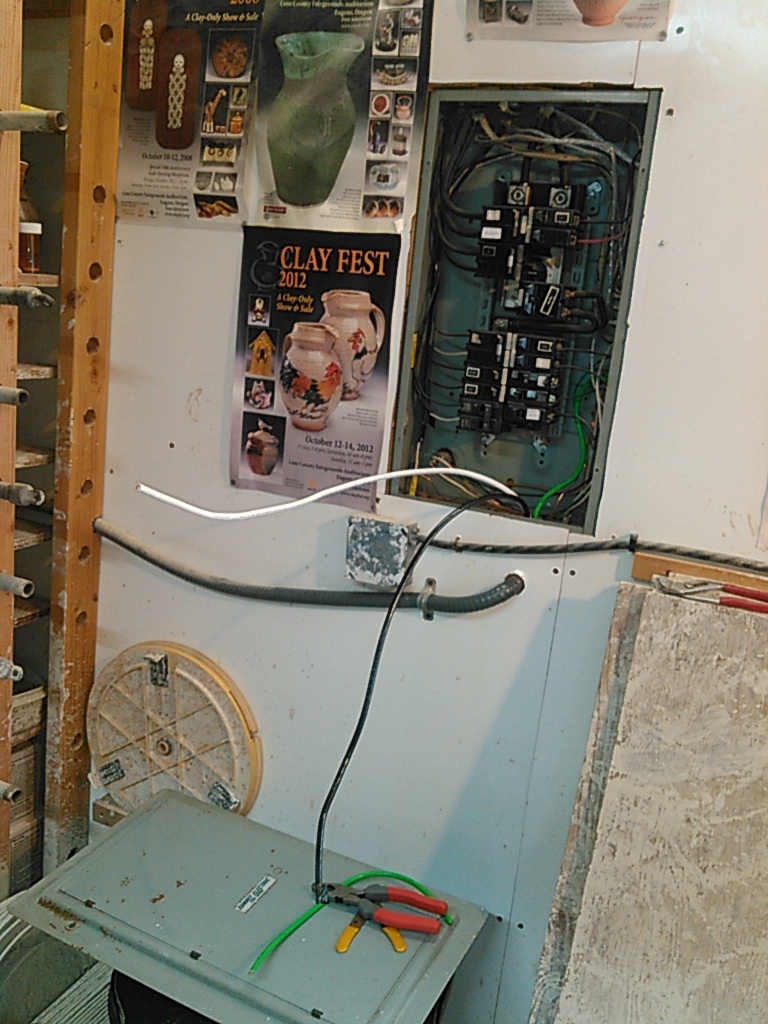
Back at the studio this morning, helping rewire another kiln. This one went wonky in March, and Laura replaced the relays, but it still was confused. Temperature reading was bouncing all over the place when it was sitting at room temp, not even firing. One of the old relays had been fried, so she thought we might try replacing the wiring, in case any of it was compromised. This was a much easier fix than last week's. We swapped out four red (control) wires leading from the relays to the motherboard, and I also noticed that one of the power leads from the formerly fried unit also looked a little toasted, so we replaced that as well. Once we put the box back on the kiln and plugged it in, it went through a warm-up cycle, announced it was a stable 65° F., and idled, just like it ought to.

The hardest part of the project was getting the kiln settled and level again. They'd traded the Left and Right kilns, because the left outlet needed replacing about the same time the Right kiln failed, so it was very wobbly on its base, rocking back and forth. We finally had to unlatch the bottom slab from the kiln, lift the body off and get everything straight and aligned (incidentally cleaning out some big rust flakes, which had been part of the problem). Lifted the top bits back on, snapped the latches in place, and programmed a quick test firing. Half hour later, it was already over 225° and climbing nicely, so we canceled the program and declared it fixed. The whole job took less than two hours.

Unlike my last kiln repair project. When last we left this tiny trouble-maker, Johnny and I had replaced the elements, but couldn't trim them to length, nor did the connectors fit over them. Laura, replacing the relays, couldn't figure out the wiring arrangement, as the new units were a different style, and had to wait until Tuesday to call the manufacturer, as, unlike potters, they don't work through Memorial Day.

I wound up buying a Dremel and cutting discs, as none of my wire-cutters would make a dent. (Club Mud had a Dremel, but it didn't work; motor spun, chuck did not. I eventually fixed that as well, with a $6.50 part from the internet.) I also took all the connectors home and reamed them out with a drill bit. Eventually, everything was trimmed, assembled, crimped, and ready to plug back into the control box.

Which was still sitting open on the table. The new relays were wired in, but couldn't be attached to the mounting plate, because of stupid bad design. Skutt designed them to attach to the plate, not with sheet metal screws, which could be just screwed in and out from the front, but with little bolts, that required somebody to hold the nuts in place in the quarter-inch clearance between the back of the mounting plate and the box. So we needed to unbolt the mounting plate, but I didn't have my socket set with me, and the mounting nuts were too tightly spaced for any kind of wrench or pliers.

I ended up taking the whole unit to work on at home. Managed to get the mounting plate unbolted, but had to disconnect the power cord and remove its hardware before I could get it free. Once the relays were bolted down, the whole works went together mostly smoothly (one of the power lead screws wanted to cross-thread, but eventually surrendered). And I could finally put the thing back together, three days after we started our one-day repair. Test-fired it last Friday night, and it was fine. All four electric kilns are now officially (knock wood) working again.

tl;dr: I'm really tired of kiln repairs right now.

Lonely

Jun. 4th, 2021 08:39 pm
offcntr: (window bear)
 
The kiln always looks so lonely after we've finished unloading it.

Unloading

Jun. 4th, 2021 07:27 pm
offcntr: (bella)
With a week of temperatures in the high 80s, it made sense to wait an extra half-day to unload the kiln. Thursday morning was much cooler than Wednesday night, even if the kiln was still potholder-hot on top. I'd tinkered a little with the fuel and air, this firing, hoping to have less over-reduction on top. The result was slightly better--fewer pots to re-fire--but a lot that were, if not oxidized, not terribly reduced either. Aggressively neutral? I've decided not to care so much.

Here's a sample of the results. A pair of pie plates, the one on the right a little paler than I'd like (most noticeable on the rim, though if the image included iron or rutile, you'd see the bleaching).

One of two full ware boards of tall mugs; hoping this means I can stay ahead of demand for a bit. Also a rather nice cephalo-cream pitcher.

A pair of pasta bowls. They haven't been selling, necessarily, but they're easy to throw and fun to paint. And they help fill up the kiln.

An aerial view of a really nice batch of dessert plates.

And of course, the return of Spider Plate! Now in dinner size! (And thank the kiln gods, it matches the first one.)


offcntr: (be right back)
1. Busy all last week, glazing, loading firing. Took lots of pictures; expect them here in a few days.

2. The trike is fixed, I think? Haven't had a chance to take it out for a test ride yet. Took four trips to three different bike shops--I kept finding broken spokes. (And one trip was because the shop cut the spoke a half-centimeter too long, and needed to re-do it.)

3. I'm also halfway through fixing the tiny electric kiln at Club Mud. Johnny and I replaced and pinned all the elements yesterday while I was firing, but couldn't cut the ends down with any tool I had, so today I bought a Dremel and some cutting discs. I also had to bring the power leads home and drill out the connectors a little, they were too small to fit over the element tails. I'd feel more pressured to finish quickly, but Laura, who's replacing relays in the control box, had to put that job on hold as well. Video instructions were for a different model unit, and Skutt was of course closed for Memorial Day.

4. Today's our 30th wedding anniversary. Have a peony. I'm out.


So many

Mar. 26th, 2021 03:41 pm
offcntr: (live 2)
We loaded the big kiln again on Tuesday, and I succumbed to an odd impulse--I did a slow video pan, showing all the pots stacked up waiting, and the big, empty space where they were going. Popped the raw footage up on Instagram, but spent a little time polishing it today. Found the perfect musical accompaniment: Lou and Peter Berryman's "So Many Pies," from their first album, No Relation.


We started loading around 9:30 am, finished by 3 pm. Contrast how the shelves and kiln looked at the start, with how they looked afterwards.

Just for fun, I calculated just how many pots were loaded in the kiln this time. I came up with 310, total. And of that huge expanse of pots from the beginning of the process, this is all that was left.

offcntr: (rocket)
In the spirit of "before and after," here's a couple of short video clips. First right after I lit the burners, at the start of the firing; the second, as I wait for the last cones to go down. Cone 8 is completely down, cone 9 nearly. Still need the third cone, 10, to drop. (The last cone is a guard cone, to let me know if I've gone too far. At cone 11, the pictures start sliding off the sides of my pots.)


No song this time, just the music of the fire itself.

Boom!

Oct. 21st, 2020 03:41 pm
offcntr: (Default)
Heard a quiet boom! from the bisque, just over 700°. On unloading, found this: three stacked pie plates, reduced to wreckage. This after a slow warm-up, and a hold for three hours at 200° F with the vent fan going.

It is so hard to thoroughly dry pots in the fall.

Sharing

Sep. 30th, 2020 11:12 am
offcntr: (bunbear)
It's been a long time since I've shared a firing; probably back to the first few times I'd fired the big (50 cubic-foot) kiln. I'd started using the small kiln, 24 cubic-foot, and one firing I realized I had more than twice the pots I could fit in. Normally, the big kiln fires a 6-shelf footprint, but it's possible to load with four, so that's what I did. The firing turned out well, and the cost per pot was enough less that I decided to keep using it.

That's also about the time I started entering more retail fairs, and selling more pots, so fairly soon, I needed to fill every cubic foot to keep up with demand. And it was nice to be in total control of the firing, running things to suit my work and nobody else's. (About this time, Tea grabbed a few of my bowls to fill out one of his kilns, and the results were, shall we say, not ideal.)

So for the last decade, I've been firing my own stuff, with the occasional test tile from Jon or Annie thrown in.

Enter the global-f**king-pandemic.

All my shows are cancelled, Saturday Market every second week--if that--galleries not reordering. I needed to fire a kiln, to restock what was selling, and cover a few special orders. But I really didn't need more pots to put in the shed.

Meanwhile, Club Mud has been doing a complete teardown and rebuild of the smaller gas kiln. They took it down to the ground, redesigned and rebuilt. Now it's just waiting on burners (an epic in itself) and a door.

The old kiln didn't have a door. It had a doorway, through which you loaded pots and shelves. But to close and fire, you just stacked up bricks until it was full, remembering to leave ports to check the cones. It was a laborious process, often taking more time than loading itself, and there never seemed to be exactly the right-sized brick to fill a given gap. So bricks got cut to fit, meaning more smaller bricks, more time needed the next time. The users decided if we were rebuilding the kiln, we needed a proper, hinged door.

They're still figuring out the door. (I'm staying out of it.) And the projected finishing date keeps getting set back, from early September, to late September, to late October.

So anyone who needs a firing in the small kiln is either on hold, or looking for other options.

Look! An option.

This is Linda. She grows plants and sells plants, planters, and the usual mugs/bowls/plates at Saturday Market. She had enough work to fill the small kiln; about a third of the big kiln.

I could easily make enough to fill two-thirds. So we're sharing a firing.

It was weird, loading a kiln with someone who isn't Denise. She's a little to eager to help, I have to tell her when to slow down and let me think. Tell her when to stop bringing pots and look for posts instead. But we worked out a good rhythm, got the kiln loaded even a little faster than usual. And it was nice having some different sized pots, things that could fit in between and around my standard sizes. Made the load a little more efficient, in the end.

I did the firing myself, as she doesn't have a schedule for this kiln. It was a little fussy, cool on the bottom, though that shouldn't affect the pots we loaded there. It's cooling now, will unload tomorrow. Hope for the best.

Stress

Aug. 10th, 2020 09:49 am
offcntr: (bella)
This kiln is giving me stress.

I don't realize it, while I'm making pots, bisquing pots, glazing them. It starts when I'm loading the kiln, trying to guess where the bad spots will be this time, deciding which pots will be sacrificial, probably un-sellable, but needed to fill the empty spots, because without the thermal mass, things will be even more unpredictable. Trying to be sure that special orders are near the top, near the back, even if it means they'll be over-reduced and I'll have to refire them in the electric kiln. Thinking longingly of my days back at the Craft Center, where the glaze was always the perfect cream-with-speckles, not dead-white or overly brown. I realize that I'm beginning to dread firing.

I spent a good bit of time trying to knock the bugger back into shape, and it seemed to have helped: it fired evenly, with a minimal adjustment of the damper. Still some oxidation in the bottom front, but most of the space was filled with work for Empty Bowls. (Who knows when that will happen again?) Top and back had some pretty dark pots, enough for nearly a full (electric) kiln's refiring, including five commissioned bowls. But other than that, it was a pretty good firing. 66 units of gas, which is dead average. Still took nearly two hours to drop the final cone, but I think I may have an answer for that, and one that may address the over-reduction.

But damn, I wish I didn't get so anxious every time I light the burners.

Fire

Aug. 4th, 2020 10:32 am
offcntr: (Default)
The kiln has been really inconsistent the last two firings, so I spent a little time on prep and maintenance, before I started glazing.

Mostly this involved hitting it with a hammer.

Brick expands with the kind of heat we subject it to, and contracts again as it cools. Potters are cheap, always planning to reuse materials when the day comes that we have to tear down and start over, so all our kilns are dry-laid. No mortar.

So the bricks can move independently, but, because friction, not necessarily mean they move back to their original location as they cool. With enough repeated expansion/contraction cycles, you can develop fairly large gaps between bricks, particularly where they're not contained, like in the chimney. 

Where they are contained by steel, in the walls, they can start bulging out.

So I took a hammer and two-by-four and banged my way around the chimney, making the gaps go away. I also pushed the bulges back in on the back and rear side walls. I bopped on the door sills, pushed the door bricks tight (this also makes it much easier to open and close the kiln). I poked my phone into the chimney and took a picture, to be sure the flue was clear. (This took a frustrating ten minutes before I realized, via flash photo, that the damper was still closed. Once I opened it up, all was okay.) I even unscrewed the burner venturis and banged them on the floor, to know out any loose scale and brick crumbs.

I must have done something right. For the first time since January, it fired evenly top and bottom, though it still stalled a little at the very end. Cone 9 was down at 5 pm, but cone 10 didn't drop until after 7. Still, even firing, reasonable amount of gas--66 units. I'll find out tomorrow how the actual pots look.

offcntr: (Default)
My last two firings were a struggle. The kiln didn't want to heat evenly, and when I did finally get the cones to drop more-or-less together, I had horrible amounts of oxidation. Around the door, along the sides, pretty much everywhere but the very top. So this time, I decided to try a different tactic. Rather than adjusting the airflow via the chimney and damper, I'd cut it off at the source.

A venturi gas burner uses the pressure of the natural gas flowing through it to draw in air through the back of the burner into the mixer, where it (duh!) mixes with the gas, then ignites at the tip of the burner, shooting flame into the kiln. This is primary air, and you can adjust it by turning a rotating shutter at the back of the burner. Secondary air comes in around the burner (or through leaks in the kiln door or walls), drawn by the draft of the chimney. With the big gas kiln, we normally set the primary air early in the firing and leave it, doing any later adjustments with secondary air and draft. But I'd been using less and less gas the last few firings, and it occurred to me that I might have in fact had too little gas in the burners for the amount of air I'd entrained. So this time, when I set the shutters at the start of the firing, opened them only two turns, rather than my usual two-and-a-half.

It wound up being a struggle. The top still got ahead of the bottom in temperature, and I still had to mess with the damper to even it out. The firing took about three hours longer than usual, and about 5 units more gas. But for the first time in ages, I had a glaze firing that wasn't a mess of oxidation.

It was a mess of over-reduction, instead.

The pots were much browner than I like. Some were still passable; others, you could barely make out the pattern. Fortunately, I have a solution.

A few months back, Mason Stains stopped making my preferred black, and the replacement tended to blister when it went on too thick. I eventually solved the problem by changing the ratio of stain to Gerstley Borate (1:2, rather than 1:1), but in the meantime, I had pots with bubbles and blisters. I tried grinding them down, and dabbing on a little Gerstley, and refiring, but while the bubbles would be fixed, the background glaze got browner, and on vertical surfaces, mugs, for instance, the picture would start to slide. What I really needed, I decided, was the ability to fire cooler, in oxidation, maybe cone 9?

Then I discovered (by blowing circuit breakers) that my new kiln was in fact, a professional model, rated for up to cone 10. So I tried refiring some blistery pots, and not only did they smooth out nicely, several of them brightened up considerably. It's still not perfect--the background glaze looks a little dirty, to me--but it's a huge improvement. And it only costs around five or six bucks per firing. So far, I've done two loads of brown pots, and I think I'll do at least one more. Here's a before and after comparison.

I wish I had a solution for the opposite direction.
offcntr: (radiobear)
Once again, I was struggling with a kiln that was heating up on top faster than the bottom. I was being proactive, starting my adjustments earlier in the firing to keep on top of the difference. Conventional wisdom is to close the damper on this kiln, presumably to make the exhaust gases take longer in exciting, dumping more heat.

Our damper has three settings marked in sharpie on the kiln shelf: 3 (with open and closed hashes about half an inch apart) the widest open setting; 2, the almost-closed setting for body reduction; and 1, about half-way between the two. No, it doesn't make sense from a linear perspective, but think of it temporally. The first setting, 1, is where the damper stays overnight, through warm-up, and into the initial part of the firing. When cone 08 or 06 drops, the damper goes to 2 for body reduction. After a half hour, you bring it out to 3 for the rest of the firing, tweaking between the open or closed mark depending on whether the kiln's hotter on top or bottom. Always adjusting for kiln atmosphere, flame flickering in the chimney.

At least, that's the theory. As I mentioned, I'd been struggling with evening the temperature, pushing in the damper half an inch, then another. At one point, around 3:30 pm, I had cone 9 completely down on top, cone 8 only halfway on the bottom, and was getting desperate. I didn't want to over-reduce my pots--dark brown is as unattractive as ghost-white as a background for paintings--so I was also carefully watching the gas pressure. 

I pushed the damper all the way back to 1--the overnight setting--brought the gas back from 1.8 to 1.6". Again, the same setting I use for overnight pre-heat. And I had a tiny brainstorm.

I'd done something similar last firing, managed to arm-wrestle the cones into submission, but wound up with a lot of oxidation afterward. Maybe, I thought, I should be adjusting the primary air as well, by turning the air shutters on the burners. Wind them back to the overnight (2 turns) setting as well.

So I tried it. And dropped cones 8 and 9 on the bottom in 30 minutes flat. Thirty minutes later, both cone 10s started bending, and continued to move together till they touched down, millimeters apart (still a tiny bit cool on the bottom) at 5:45 pm. 45 minutes and 2 units of gas sooner than usual.

What happened? I think it had to do with flame length.

If you've ever adjusted a bunsen burner (or an oxyacetylene torch), you know that you get a big, mushy flame when you first light it. Then, as you add the air (or oxygen), the flame gets shorter, tighter, hotter. The hottest part of the flame is just below the tip. 

In a kiln, changing the damper doesn't affect the length of the burner flame; it just pulls it around in the kiln. Reducing the primary air, though, does. The flame gets longer, and in a down-draft kiln, doubles back on itself, dumping more heat (from the tip, remember) in the bottom of the kiln.

When Steve taught me to fire this kiln, twenty years ago, I learned to control atmosphere and heat from the damper. Primary air was something you set and left alone. I should have known better--when I fired updraft kilns at Viterbo, we had shutters on the blower fans to control air. At Buck's Rock, I could tweak the air shutters and damper on that updraft kiln to put the heat (and reduction) anywhere I wanted. I don't know why it took me so long to realize I was ignoring a potential tool for firing here.

I feel a little like a photographer who's been controlling exposures by changing the shutter speed, accepting the occasional wobbly, blurry shot, never thinking that changing the F-stop could accomplish the same thing.
offcntr: (Default)
I've been keeping firing logs forever; if I dig far enough into my filing cabinet, I can probably find logs from my Craft Center days, possibly even graduate school. They're a good way to keep track of how often I fire, how much gas I use, what firing strategies. Sometimes they're even useful in predicting what I should do next time.

Sometimes.

Our big gas kiln is weirdly unpredictable. I don't just mean the oxidation spot, which seems to move around from firing to firing. Firing strategies that work for months, even years, will suddenly crash, for no perceptible reason. For the longest time, I had a schedule that fired reliably at eight hours overnight pre-heating, twelve to thirteen hours more the next day to reach cone 10, with the kiln about half a cone hotter on the bottom. I could shut down at cone 10/9.5 and rely on heat rising to drop that last half cone on top on carry-over.

Jon couldn't match my experience. No matter what he tried, even if he tried the exact same settings (possible after I installed gas gauges on all the burners), he'd always fire hot on top, cooler bottom. I privately felt a bit smug, thinking I had a better handle on firing this kiln than he did.

And then, about six months ago, it abruptly switched on me as well. The bottom was staying as much as two cones cooler than the top, necessitating a lot of fussing with the damper, trying to slow down the top long enough for the bottom to catch up, wasting time, wasting gas.

This is where the logbook comes in handy: trouble-shooting. I have a record of a series of attempts, what helped, what didn't. What to try next time. I record the times of adjustments, gas, primary air, damper. Pyrometer reading, and notes on what I'm trying to accomplish at any given point.

Gas pressure is read on gauges on the individual burners, as mentioned. There are valves on each burner, plus a big emergency shut-off valve where the pipe comes in from the meter, in case we have to shut off everything at once. Pressure is measured in water-column inches; I generally pre-heat overnight at 1.6", then turn up to 2" (or more recently, 1.8") for the day's firing. For now, I keep pressure the same at all burners, though I suppose I wouldn't have to.

Primary air is the air going directly into the burners. Speeding gas pulls in air via the venturi effect. The amount of air is effected by the constricted shape of the burner, the speed/pressure of the gas, and the size of the opening permitting in the air. We can't control the first--burners are cast iron--and already talked about the second, above. The third is controlled by a disk-shaped cover, threaded over the gas pipe at the back of the venturi. By spinning the disk, you can move it closer or further from the opening, changing the amount of primary air. I generally fire with the air open 2 turns overnight, move it to 2.5 in the morning when I turn on the gas.

Secondary air is what comes in around the burners, through the burner ports, peepholes, gaps in the brick. Hot gases in rising in the chimney create draft, which pulls in this secondary air. By opening and closing the damper, a piece of kiln shelf that slides in and out of a slot in the chimney, we control the cross-section of flue, and hence the secondary air. Body reduction and the neutral-to-reducing atmosphere later in the firing are generally controlled with the damper.

Londonderry Air is something else entirely.

The pyrometer is a digital read-out attached to a bi-metallic thermocouple that's slid into a ceramic sleeve, protruding into the kiln. Heat from the kiln causes a current in the metals that's then converted into temperature in degrees Fahrenheit or Celsius. It's not actually that accurate, which is why we use pyrometric cones we can watch through the peepholes to determine when we've hit temperature. However, the pyrometer, like an instant-read thermometer in cooking, can give us a snapshot of the firing, tell us whether we're still gaining heat or have stalled. Like the time, it can also be a handy reference when you're comparing different firings.

My notes are usually things like "cone 08 is down, start body reduction" or "tweak the damper for flames in the chimney" (a way to gauge kiln atmosphere), and occasionally "why won't the bottom heat up, dammit!" Descriptions of what's happening, as the other columns give the when and why.

Before and

Sep. 22nd, 2019 09:43 pm
offcntr: (spacebear)
Thought I'd take some before and after pictures last Sunday, loading the kiln. Here's the kiln car, waiting for the pots, only a cone pack in front of the bottom peep hole.

Here's a table full of pottery, waiting to go in.

Here's the stacks of shelves waiting to go onto the table, and eventually, into the kiln.

And here's the finished load, just before closing.

Yeah, that's right. Six hours of packing and stacking, and I forgot to take the "after" pic. I was just that tired.

Only a test

Aug. 9th, 2019 03:29 pm
offcntr: (Default)
I've been struggling a little with my black stain, the last two firings. For years, I've been using a chrome-free black stain, Mason 6616, mixed with Gerstley Borate, 50:50 by volume. It was a little fluid on vertical surfaces, but overall reliable. Which is why I was so unhappy when I learned last spring that Mason had stopped making the stuff.

The thing is, chrome is a refractory--it resists melting. Because I want the stains to melt into the surface of my glaze, using as little chrome as possible is a good idea. I had to use it for green, but at only a quarter of the volume, it was unlikely to be a problem. Problem being defined as bubbling, blistering, refusing to melt smoothly.

Which is a problem I have with my new black stain. I ordered the one with the least chrome content, but it's still around 25-30% chromium oxide.

So I changed the proportions. I no longer mix with Gerstely Borate half-and-half. Now I use two parts Gerstley to one part stain. Even so, I have to be careful not to apply too thickly, else blisters appear. I can grind them down, but can't really sell the resulting pot as a first.

I considered refiring them to smooth them out, but I've had problems with that in the past. Glazes get more fluid on refire, more likely to run. I also tend to see them get darker brown, as reduction brings more iron out of the clay. If only I had some way to fire them cooler, say, cone 9, in oxidation.

Then last week I had an inspiration. As I mentioned, after having to rewire my studio, the new electric kiln is a production model, a Skutt 1227 PK. What this means, besides it requiring a bigger circuit breaker and heavier wiring, is that it can fire to cone 10. In oxidation, because an electric kiln doesn't burn fuel.

So I boxed up a dozen unsuccessful pots, brought them home, ground down the blisters. Dabbed on a little straight Gerstley, to make sure they smoothed out. I also had a couple of pots that had gotten scratched in handling, so I put them in as well. Set the kiln Fast Cone Fire mode, going to cone 9, turned on the vent and pressed the Big Red Button.

The next morning, the kiln flashed Complete. It'd taken a bit over 5 and a half hours to reach temperature, was already back down to 665° (from a high of 2300°). It took the rest of the day to cool it safely down to open, but the results are gorgeous.

Blisters and bubbles gone, glaze still creamy, with iron speckles and warmish tone. And one scratched casserole, which had been a little over-brown, brightened up nicely. I'd rehabilitated over $350 worth of pottery, for about 80 kilowatt-hours of electricity.

Wow. Just wow.

I'm gonna have to reign in the tendency to refire everything that comes out of the big kiln with problems, but for a specific problem set, I've got a new solution.

Wired

May. 28th, 2019 07:43 pm
offcntr: (Default)
So last year I purchased a new kiln. Well, an old, used, but very well maintained kiln, a Skutt KM 1227 electric (twelve-sided, 27 inches deep) to replace my well-worn, also used Olympic of the same dimensions.

The Skutt is computer-controlled, which is a huge improvement, as it means I can program it to fire itself at a safe, measured pace, with holding time built in to drive out excess moisture if need be, and just walk away. Go to Saturday Market. Go to bed. The kiln turns itself up, and eventually, turns itself off.

Except when it doesn't. A few times over winter, the breaker would trip, and I'd come back to find the kiln blacked out and cooling down. I'd generally reset the breaker, grumbling under my breath, and start the firing over.

Last weekend, the breaker tripped twice. No idea how close to fired we came, as the power failure wipes the computer memory. The pots look pink, but feel a little... clunky. At least a few cones under-fired.

I spent Memorial Day afternoon unscrewing the connection box on the wall, looking for shorts. Opening up the control panel, likewise. Nothing obvious jumped out at me, though I did spend some extra time redoing the connections I'd had to undo when I installed the new (new, not used) Envirovent, as I'd realize the conductors would fit better in the buss block if I didn't twist the wires.

I'd closed up the control box and just about given up when I noticed that the model info panel read KM-1227-PK. 240 volt, 1-phase, 60 amp.

Wait, what?

Apparently, I got a better deal on this kiln than I realized. The PK is short for Production Kiln, the top-of-the line, cone 10-capable Skutt model. The Rolls Royce of studio electric kilns. Woot!

Except.

My old Olympic was a 48 amp kiln. The other 1227's I knew from Club Mud, both the old kiln sitter model and our new computer-driven version are both 48 amp kilns. You want 25% over capacity, so when I wired in the kiln, I installed a 60 amp breaker. Now, running a 60 amp kiln on a 60 amp breaker, there's no room for error. The tiniest power surge, and pop! goes the weasel. I talked to Perry at Skutt tech support this morning, and he told me I needed an 80 amp breaker. I'd also have to upgrade the wires, from 6 AWG to 4 (wire gauge, like sheet metal, gets bigger the smaller the number).

So I took a run out to Jerry's this afternoon, had them cut 12-foot lengths of no. 4 conductor--black, white, green--then found out they didn't have 80-amp breakers in my box's style, just 70 and 90. I worry 70 might keep tripping, and I don't want to go to 90, as I don't feel it's safe. The whole point of a circuit breaker is to trip when dangerously high current is running; I don't want the wiring to go before the breaker.

So I spent the evening wrestling fat wires through a skinny conduit, connecting the kiln end and the ground, leaving the remaining two leads hanging until I can swing by the electrical supply tomorrow after the Club Mud meeting.

So I can finally finish that bisque. Third time's the charm?
offcntr: (window bear)
Well, it's been three days since I unloaded the test firing. I can finally talk about it without flinching. It was a qualified success.

We reached temperature, top and bottom largely even. We didn't take much more time than usual, and the gas usage was right on average, 34 units.

The reduction was awful.

I've talked it over with Linda, who fires next, suggested some ways to make it better. Reduce the primary air (air through the burners, controlled by opening and closing a threaded shutter), maybe use the peephole in the chimney as a passive damper. Don says you really need to be able to smell the unburned gas, which is way more reduction than I'm used to in the inside kiln. Whatever happens, it's out of my hands now.

The firing wasn't a total disaster. I had lots of white pots in my stuff, little or no copper red in anyone else's. But Nicole's cobalt crawling glaze mugs looked good, Jon's servers and some of his mugs were fine, and Linda said her two mugs and fox vase, while not ideal, were certainly sellable. Don's two test bowls looked normal to me, but Brian got mostly cobalt in his bowls, though there was a little copper red inside two. A couple of my pots, near the top back, showed the opposite effect, over-reduction giving a peachy bloom to my white base glaze. Go figure.

There was one spot of perfect reduction in the entire kiln, on the back left side, just above the bag wall. Just big enough for one pot; guess which one?

Squirrel!

January 2026

S M T W T F S
     12 3
45678910
11121314151617
18192021222324
25262728293031

Syndicate

RSS Atom

Most Popular Tags

Style Credit

Expand Cut Tags

No cut tags
Page generated Jan. 6th, 2026 03:51 pm
Powered by Dreamwidth Studios