So when a vaguely familiar Asian woman came into the booth, my brain was going, Why do I know that face? It was Mee, down from Portland, there to pick out a piece from me. She got the sunflower dinner pasta bowl, and a hug.
No, I'm not hanging it up where anyone can see it. (Except here.)

Piéce de resistance
May. 5th, 2025 09:40 am
Was sorting through my tools and stuff box at Market Saturday, trying to make more room for my magnetic shelf signs. Threw out a lot of junk, including fossilized poster tack that I used to use on the signs. Down at the bottom, I found this historic document.It's the certificate of flame resistance, required by our fire marshall, for my second booth tarp, back in 1998.
Think I still have that tarp in the shed somewhere. Don't use it at Market anymore, so this is probably good to toss.
Out of the past
Jan. 7th, 2025 09:54 amWay back in the summer of 1988 and 1989, I taught ceramics at a summer camp in Connecticut, called Buck's Rock, I've mentioned it here before. A lot of the counselors were from Europe, mostly the British Isles, here on a program that got them work for the summer, a couple of weeks travel time afterwards, and a guaranteed ticket home. There were a couple such programs, CampAmerica, BunaCamp, we had folks from both. One of the English computer shop counselors and I bonded over a mutual love of The Hitchhiker's Guide to the Galaxy; he was Arthur, I Ford. We'd exchanged a few letters in the years since, I still sent him my Christmas letter, but we'd mostly fallen out of touch.

So imagine my surprise to see his name pop up on my new followers notices. It's not an uncommon name, so I messaged asking if this was indeed Arthur Dent of Buck's Rock. Didn't get a reply, more-or-less forgot about it in the hectic run-up to Christmas.
Finally heard back on New Year's Eve Eve (December 30)--it was indeed him--and that afternoon, found a package on my front porch! He'd sent me this book, along with a six-page hand-written letter! (After 30-plus years at keyboards, he's getting back in touch with pen and paper...) He's doing well, kids grown, just retired. Has apparently been lurking around my internet even back to the Saturday Cafe days. I'm really glad to be back in contact. Someday, I hope to get my passport situation sorted out so we can actually visit in person.
The book is lovely, a reflection on friendship, with beautiful drawings. I've been rationing out pages over the last week, and thinking of old friends and times past.
A Potter's Journey
May. 14th, 2024 03:59 pm
Adapted from the Artist's Talk I gave as visiting artist at the UO Craft Center, Spring 2024.So the farm I grew up on in Wisconsin has red granite bedrock. Over geologic time, it's eroded into a sticky red clay subsoil. So you could say my roots have been in clay for a very long time.
I didn't set out to be a potter. I was going to be an animator, or a cartoonist, or a commercial artist. I was a terrible pottery student--took me well into my second semester to finally master centering. Meanwhile, I worked as an editorial cartoonist for the local diocesan weekly newspaper, and as a graphic artist, first for my college publicity office, then at a local four-color printer. But I kept coming back to clay.
I bought my first wheel and kiln from a student in the art history class I was teaching as a sabbatical replacement. It wasn't a practical set of tools--an 18-inch electric kiln sized for firing dolls' heads, and a home-brew kickwheel with pipe frame, concrete flywheel and bright orange tractor seat. I spent all my evenings and weekends in the college pottery studio, trading glaze mixing and kiln loading for studio space.
I probably would have stayed there in La Crosse, working my way up to art director and throwing pots in my spare time, but for my friend Susie. She was another post-college potter, haunting the studio in her spare time, and she took a summer workshop at Tuscarora Pottery School. She signed up
for two weeks, wound up staying the entire summer, came back raving about the experience. So the next summer, I signed up.
Tuscarora literally changed my life. The school is located in an abandoned mining town in the central Nevada desert. There were only two students, daily demonstrations, and no distractions. In two weeks, we were able to make, dry, glaze and fill the entire waste-oil fired kiln. I'd never had that kind of concentrated studio time before, and came back from my two weeks off from the print shop inspired and energized.
And then I got laid off. It was only for a week, I took vacation time to cover, but I also took time to reevaluate where I wanted to be in my life, and to research graduate schools. I wound up applying to six--three close in, including the University of Minnesota, three further afield, Maryland, Arizona, Oregon. Arizona sent a form rejection letter with a rubber stamp signature. Minnesota wasn't accepting new grads that year, Warren Mackenzie was on sabbatical. Oregon... said yes.
Graduate school was all the best stuff, but magnified. Unstructured time, unfettered studio access. I fiddled around, trying to find my path, made some wildly un-functional pots, then stumbled on a theme that really resonated. I was taking a class from a professor who was very into dream imagery. I don't remember mine, much (unless they're really scary anxiety dreams), but thought it might be fun to work with childhood memories. Stripped down, with all the layers of adult revision and editing removed, I had a simple story, six pages of rubber-stamped text and pinched figure illustration. And people kept coming into my studio to peek under the plastic and read the latest installment.
I'd been a children's storyteller on radio in Wisconsin, as well as a graphic artist, and those "story tiles" combined the two interests with clay. They became the basis of my thesis work, culminating in an expanded version featuring my brother and me, my Dad with a calf on his shoulders, and a life-sized ceramic cow.
Graduate school doesn't really prepare you for real life.
I thought I was going to be a college professor. Shot slides, paid my College Art Association dues, read the Chronicle of Higher Education wants ads religiously. I sent out applications, so many slides. I got one bite through the CAA--a summer arts camp in Connecticut that saw the combination of clay and kids stories and flew me out for two summers. I don't remember how I heard the Craft Center was hiring a Resident Potter--it may have been as simple as being next door at the Cultural Forum office organizing the Willamette Valley Folk Festival. In any event, it was a godsend, a chance to stay in clay. Paid teaching time, a small stipend, keys to the studio, and all the recycled clay and glazes I could eat.
It wasn't really a living, more a part-time job. So I washed dishes for a week at the Red Lion, before my ankle went out. Answered phones for Harry & David one holiday season. And then I got introduced to Will.
Will Mattox of Slippery Bank Pottery was less a potter than a pottery entrepreneur. He had a little factory out west of Junction City with a team of women doing slip-casting, glazing and firing, while he did the throwing and the more elaborate decorating. He had two vans, which he'd load up with pots every summer. He'd do the top-tier western art shows; his kids worked their way through college taking the other van out to second-tier shows.
When I met him, he'd just signed a contract with a mail order catalog to supply hummingbird feeders, and needed help keeping up with demand. A college friend referred me, and soon I was throwing nine dozen hummingbird feeders a week. Over the next two years, I made hummers, mugs, French butter dishes, egg separators, luminaria, mini-pie plates, basically everything under a pound-and-a-half in his product line. At one point I was making 240 spoon rests a week (and will never make another). When I wasn't throwing, I was re-casting his slip molds (made from Pyrex casseroles with the logo ground off). I got a thorough grounding in production pottery, with pay. And then he laid me off.
I'm beginning to see a theme here.
It was just after Christmas, 1992. I had three months to make pots and build a display. My friend Kathy had a Saturday Market booth she was willing to share. And Off Center Ceramics was born.
It was rough, at first. There were weeks we got skunked, weeks we sold seven dollars and owed Market ten (plus ten percent). But things got better. A big change came when I changed my decorating. I'd been painting on pots since Tuscarora, mostly floral patterns; now I started painting animals, hens and roosters first, then elephants, otters, bunnies. People kept suggesting new patterns; I kept saying "Oh, that sounds fun." (At this point, there's over a hundred in my repertoire.) It helped that for the first five years, I was still teaching at the Craft Center.
It was also at the Craft Center that I started sculpting again. I'd given up on story tiles after grad school--just couldn't summon the necessary child-like optimism in those lean days. But I got inspired one day by a scrap of clay leaking out of the extruder. The ruffled edge looked like fabric, so I made it into a scarf on the head of an old woman (who was also a teapot). I used the same slab-sculpting techniques I'd invented for my thesis work, and also started incorporating the same interest in storytelling. Pieces were frequently inspired by books I'd read, or songs I played on my KLCC radio show. I showed and sold regularly through the Alder Gallery until it closed, and I still try to find time for at least one sculpture a year for the gallery at Clay Fest.
It's been sixteen years since I left the Craft Center, and a lot has happened since then. I joined Club Mud, a pottery co-op based at Maude Kerns Art Center. We bought a house in 2000, chosen in part because it had room for floor-to-ceiling bookshelves, but mostly because I could convert the family
room addition into a home studio. I now do all my work through bisque at home, though I still glaze fire at Club Mud. (I bough a used gas kiln over a decade ago, but have yet to have found the time and space to reassemble it.) I started going to out-of-town art fairs, at one point doing as many as six to eight a year. I picked up a few galleries, most of whom approached me at shows.
I'm traveling a lot less these days. When the lockdown lifted in 2020, my Saturday Market sales doubled, and have stayed high ever since. I've been able to cut my road shows down to three, a much more manageable number as Denise and I get older.
I'll keep doing retail fairs though, because of the connections I've made--I've become the family potter to a lot of folks over these 30 years. In the last few, I've found a new audience: college students starting to furnish their first apartments, drawn by a combination of relatable animal imagery and reasonable prices.
I turn 65 years old this October. It's been a long ceramic
journey, but I'm in no hurry to retire. I'm eager to see where it takes me next.
Frank Gosar
May, 2024
Thirty something
Mar. 29th, 2023 08:14 pm
It was April of 1993. I was still working at the UO Craft Center for part-time wages, but I'd been laid off from my other part-time gig, throwing for Slippery Bank Pottery, just after New Year's. My friend Kathy Lee was looking for a partner to share her booth at Saturday Market. What did I have to lose?
I spent winter term making pots. Bowls, plates, animal-handled mugs. Animal banks, baking dishes, pie plates. Also candle sticks, orange juicers, whistles and ocarinas. Cookies jars and honey pots. Basically, I threw everything, waited to see what would stick.
It was a very low-risk experiment. We each paid $5 plus 10% of sales. Kathy had a pipe-frame booth she'd bought from a retired machinist who was making them in his garage, and I built folding shelves in the Craft Center wood shop. Some days were good, some days were horrible. Some days were horrible, and it rained.
But we endured. Denise and I would come down and set up, then she stayed while I drove out to Lane Community College for my radio show. After our first season, we got a reserved booth, so we could set up early. It wasn't the best space, facing East Lawn. Saturday Market didn't have anything in the way of security back then, so around 3 pm, when the pot dealers moved in, legitimate business went elsewhere. Kathy Lee decided Market wasn't a good place for her quiet pots. I gradually shifted from floral patterns to animal patterns, and sales picked up. We got a better reserved space on the south edge, right in front of Mount St. Market, where the steam vault had exploded the previous year, catapulting the manhole cover into the air.
I started applying to out-of-town shows, first nearby, Bend, Roseburg and Silverton, then farther afield, up into Washington state. (I considered doing California shows, but every time I was ready to commit, another economic bubble crashed: first aerospace, then tech, dot.com, financial markets. I never got closer to the California border than Ashland.) I'm doing fewer road shows these days, down to three currently. Still making as many pots, filling the 50 cubic-foot kiln every couple of months, but selling much better close to home.
I started my website in 2002, experimented briefly with Etsy--a bad experience, like the worst consignment gallery ever--began this blog in 2014. In 2020, my younger potter friends convinced me to start an Instagram, which turned out to be a good way to stay connected through lockdown and beyond.
And this year? Off Center Ceramics turns 30 years old!
Happy Birthday to us.
A walk in the woods
Oct. 8th, 2021 06:50 pmThere are actually four different parks around the lake. My favorite is Kirk Park, across Clear Lake Road from the dam. I used to drive this way every two weeks, delivering hummingbird feeders to Slippery Bank pottery, and we'd walked around the park a few times back then.
28 years ago.
It's been expanded a bit since then, more paved paths, which made it a bit easier for Denise to navigate. Didn't see a lot of bird life, beyond a couple of egrets as we drove in, but lots of lovely fall colors.


Red oak and vine maple...


...something I don't recognize, and something I think I do. Shiny red leaves, in clusters of three; I think that one's poison oak. I did not touch it to test. The lacy green leaf in the middle is our native Evergreen Blackberry, much rarer than it's invasive cousin, the Himalayan Blackberry.


Wild rose hips also gave a lovely pop of red, especially when framed against a blue pond.


They'd cut down a few old white oak trees. Amazing patterns. I tried counting rings on the stump, but they get so fine as you move outward.


I don't know what variety of pine or spruce this is, but there were two, covered by tiny cones. And as we were leaving, we met this smol, fierce friend on the path.
Came home and worked on drawings for a book project, then tried to go out for supper, but our favorite Indian restaurant is doing take-out only, so we ordered Chicken Makhani and Lamb Koorma, with rice and naan, and took it home to eat.
And the chocolate potato cake was fabulous!
Back into Africa
Aug. 1st, 2021 06:57 am
I feel like I've used this theme before, though possibly with different mugs? I'll have to get a rhino from the new firing to add to the safari.
Overcast, muggy day, unusual for Oregon. It rained for about three blocks of my morning trip in to Market, but stopped by the time I got downtown. It also started spitting in early afternoon, just long enough to convince me to haul all my empty boxes (and Denise's extra paper product) into the back of my booth, crowding me for the rest of the--rainless--day.
My space is actually quite comfortable on hot days, at least until load-out. The back of the booth, and space behind it, is shaded by a magnolia tree, and on hot days, thermals from the sidewalk in front actually pull a cool breeze from the back through my booth. Packing up at 4 pm, largely done out front, is miserable, and I come home drenched in sweat and ready for a cool shower.
Had a woman in this morning who'd seen my mugs at Great Harvest Bakery and asked about the artist. Girl at the counter was a brand-new hire, didn't know anything, and the other employee was on the phone, but the woman checking out ahead of her turned around, told her all about me, how much she loved my work, how many pieces she owned, and how to find me at Market.
I feel vaguely famous.
I had several people stop and look at the work early on, and promise to come back later to buy. A few of them actually did, including the young woman who brought her family in on the second and third visit, before buying a large peacock-pattern serving bowl. Early on, a pair of young sisters stopped in, gave everything a thorough looking at, and younger one says, I'll have to come back with more money. I smile and agree, give her a card and tell her to come back anytime.
Fast forward to 4 pm. It's been a reasonably good day, but my brain is melting, and I'm starting to pack up. Suddenly, I'm the most popular vendor at the Market. First Cara and Jeremy--the couple who've been replacing their boring dishes, one or two a week--stop in, flustered at being late and going through the soup bowls. Then a red-headed man on a bicycle, wearing a fox mask, asks if I remember selling him a fox plate, and replacing it when it broke. I honestly have three brain cells left at this point, none of them in facial recognition, and admit as much to him. He understands, says he really just needs another fox pot to go with it, so I show him a soup bowl, painted mug and stew mug. He decided on the bowl, and as I'm wrapping it, the sisters come back.
They now have money, little sister wants the hummingbird soup bowl, and I say I'll help them as soon as I finish taking fox-mask's card. I wrap it up, and they ask if I can take Apple Pay.
Sadly, I can't. Not even sure if Android supports it, and I'm pretty sure Square only takes it with their fancy blue-tooth processor, and I only have a swiper. I offer to let them take it now, pay me in two weeks, but they won't be here then. The bowl goes back on the shelf.
Several minutes later, after Jeremy and Cara have left with their choices, girls are back. Don't put it away yet, our stepmother is parking the car and we'll be back as soon as she gets here. They then wait on the sidewalk near my booth, on the lookout, and eventually come back with a credit card to buy and carry away their bowl.

So that's four soup bowls--$100--after closing.
I had another fellow wheel up on a bicycle around mid-morning, asking how long I'd been at Market. About 28 years, I replied. Oh, so you know what happened right here? He asked, a little disappointed. Mount St. Market? I was here the day it happened, I reply.
He says he loves to tell new vendors the story, and proceeds to inflict it on me as well, suitably exaggerated. About 25 years ago, a steam vault ruptured under this manhole cover, blowing it into the air and venting a huge plume of steam. It was during take-down, fortunately, and no one was injured, although Alex did drop a box of pots. I was around the corner, coincidentally right by another manhole, and was more than a little worried there'd be a chain reaction.
Mr. Historian seemed prepared to hang around talking about it all morning, but fortunately, a customer from Roseburg stopped by to pick up his special order octopus pie plate, so I was spared.
I'd been volunteering at KLCC for several years by then, hosting the Saturday Cafe folk music program. As was common at the time, Radiothon offered a variety of premiums--CDs, tote bags, NPR coffee cups. They also offered a KLCC mug, but it differed from the national version in that it was handmade, by a local artist. Gil Harrison did the first ones, in porcelain with logo brush-painted in cobalt. When I took over, I reversed the color scheme: stoneware with white glaze, logo brushed in wax resist, then dipped in cobalt blue glaze over the bottom half of the mug. I think they were paying $20 each, and ordered a batch every spring and fall for several years. Eventually, they decided to change up again, and got sand-blasted glass mugs from Dave Winship.

The other commission was one big paycheck, with soup as well. The St. Vincent de Paul Society's annual state conference had been planned fro Portland, but the organizing committee there dropped the ball, and Eugene picked it up. One of the locals, a farmer with a strong commitment to food security, pitched the idea of a simple bread-and-soup supper for one the meals. The soup came from West Brothers, at the time best known for their BBQ restaurant, the bread from Metropol bakery. Bread boards and knives at every table came from the thrift store, and the centerpieces were home-grown flowers in mason jars, each tucked into a thrifted shoe. Paul also knew me through my church, where I'd done a bowl sale to benefit their food pantry, so convinced them to commission 200 soup bowls, stamped with the SVdP logo, so each attendee could pick out their bowl and take it home afterward. It was a huge check, late in summer when our income was thinnest (between terms at UO and slack time at Market), and on top of that, they invited us to the supper. Watching people so visibly appreciating my work, picking their bowl and showing it off to their friends, was greatly encouraging at a time when I was questioning whether I really could make a living at this.

I've done a number of other "branded" pottery projects over the years. Two different sets of mugs for the Newman Center, one with the church logo and one for a retreat--"Metanoia"; Environmental Law Conference mugs, stamped with a pic of the earth and dipped in green glaze, Class of '77 beer steins for my high school reunion (my classmate Larry, a home brewer of note, brought the beer). I also did reunion mugs for the Hoedads, a tree planters cooperative with deep roots (you see what I did there) in Eugene political and social culture. I turned a few down as well; the FabTrol corporate mug, featuring a troll in their logo, just looked like way more trouble than it was worth.
Somewhere in there, I began making employee appreciation mugs for the city of Eugene, a job that continues to this day. And of course, I survived the start of the pandemic, when all my retail shows were cancelled, in part because St. Vinnies ordered another 200 bowls, and Great Harvest Bakery decided they wanted custom mugs.
Would I take on another such project? A couple of years ago, I'd have said no. I might pass them on to a younger, hungrier potter. But sometimes they're easy, I already have the stamps or molds. Sometimes they're an interesting challenge. Sometimes, they're just fun.
You never know.
I usually do about three electric kiln firings every other month, averaging around 90 kwh per firing. Already this month I've done four cone 9 glaze firings, to remedy the over-reduction in my last gas firing, and I'll probably do at least two more. At 120 kwh apiece, that comes out to... a whole lot of electricity.
But the results are so worth it. Here's the latest batch.

I should see if Georgies carries plate setters--little mini-tables of ceramic refractory that stack atop each other. It would make refiring these guys so much more space-efficient.

Next time, I'm gonna take before and after photos of a refire. Believe me when I say, these look much better!


I have butter dishes again! I completely sold out of them at Holiday Market last year. I've sized them up a little; previously, I'd made them to accommodate the short, fat butter cubes that are more-or-less standard here on the west coast. But customers tell me that organic butter uses the long, skinny sticks more common back east. (And in fact, I bought a couple of pounds in that form at the Grocery Outlet that were from my hometown creamery: Grassland Butter, of Greenwood, Wisconsin!) So these new dishes are still as broad as before, but a good inch longer, to take both styles. If you buy butter in one-pound blocks, though, you're still gonna have to cut them up.
Historical artifacts
Jan. 29th, 2021 06:07 pm
Got a nice email recently from Longview, WA, from a woman who attended the University of Oregon, oh two decades ago. Eva sent me a picture of one of her treasures from those days.It's an incense dragon, and it's an old one. Copper red head over a temmoku body, and that's the Craft Center glaze from a Craft Center firing.
The big gas kiln at Club Mud holds heat much longer than the kiln at the EMU, so iron glazes tend not to have much black. Iron crystallizes during a long, slow cool-down, so a brown/black iron glaze, like a temmoku, comes out mostly brown, instead of black breaking brown on the edges. So this little feller dates back to sometime before 1998, when I moved over to Club Mud.
She says it's been years since she's been in a place where she could burn incense--smoke alarms are everywhere--but still likes his friendly presence in her space. It lives in the bathroom these days, next to a battery-powered candle (again, because smoke alarm). Seems it now has a new function.
I have a lot of people--who apparently can't read signage--ask if the nose-breathing dragons are tooth brush holders. Good to know that the mouthies can also take up the challenge.
Christmas with friends
Dec. 15th, 2020 05:21 pmTheir smallest tree was still four feet tall, and I was about to take it and cut it down, when I noticed one hanging from the awning of their RV. Is that one for sale? It was, in fact, 3-and-a-half feet high, 35 bucks. I bungied it into my basket, and pedaled back home.


Got it in the tree stand, slightly crooked--it's damn near impossible to hold it straight with one hand while turning the set screws with the other andstanding far enough back to see if it's leaning. I finally just gave up and cranked it in tight. Like me, it's a little off-center.
Watered it and watched whether the cats were gonna bother it for over a week, before we finally had a chance to get out the ornaments. For once, Tiki didn't want to play with the light strings, though Flynn was more than happy to help Denise pick out ornaments.
Almost every one tells a story. Some were made by friends, potters we know: Michael Fromme, Barb Haddad, Dan Young, Robin Russell. Some we bought from neighbors at art fairs, like the lovely copper-plated oak leaf. Some were gifts from friends over the years. Some we made ourselves, in the porcelain ornaments class I taught for ten years at the UO Craft Center. One of the loveliest ones is Denise's work, a beadwork candle she made after taking a class at the Craft Center. I always try to position a light behind it, to let it shine.


None of our current cats are really that naughty, but we used to have one who'd steal ornaments, so we tend to put soft and non-breakable ones at the bottom of the tree. (We're still looking for the little stuff pig from Oxfam that Sparky stole one year.)


Cats are a consistent theme, of course, though not surprisingly, bears also make an appearance.


Mostly they're from here in Oregon, though a couple date back further. I made the little gold-foil Santa Bear from scrap stock and acetate at La Crosse Printing, and the little rocking horse was a gift from another art major back at Viterbo.


Other things just caught my eye--the hand-painted wooden owl, the iridescent copper leaf. Following the art fair circuit, there's always beauty around.


And there's always memories in the box, brought out and scattered over a little tree, to light our way through the darkest part of the year.

In the summer of 1990, while I was was working at a summer camp in Connecticut, I took a trip on my day off to Cornwall Bridge Pottery. I was ceramics shop head that year, and thought the kids would enjoy a field trip to a real, working pottery, so I thought I'd scout around.Cornwall Bridge was founded by Todd Piker, one of Michael Cardew's American apprentices. He was very friendly, enthusiastic about a busload of kids showing up. The pottery made wood-fired ware, English-craft-revival-meets-early-American, and the day I arrived, they were preparing to fire their wood kiln. I watched them sorting and wadding pots, stacking wood, poked my head into the kiln. But mostly, I watched their decorator.
I'm sad to say, I don't remember his name. He was a local potter, had his own studio, but came to work for Todd one or two days a month, just painting on pots. He was doing early American birds as I watched him, drawn in iron oxide, one after another, amazingly consistent, amazingly fast. I couldn't imagine being able to work like that.
Last Friday, after a week's glazing, I was finishing up with soup bowls, painting half a dozen hummingbirds, and I found myself thinking, Oh my god! I'm that guy!
Tempestuous
Sep. 3rd, 2020 08:30 pm
Got an email from deep in the past this week, asking for information about a sculpture from 2003.Rebecca and I would like to find info regarding the artwork "Prospero Raising the Tempest" such as price, date of purchase and if it was bought through you directly or a gallery (maybe Alder Gallery). Any info will be greatly appreciated.
This artwork is now in the Aimes University Art collection in Des Moines, Iowa since Rebecca donated many artworks there.
We still have "Soji [sic] at the Wheel" in DC.
A follow-up email from Rebecca clarified a bit: The piece is actually on a two-year loan to Iowa State University in Ames, Iowa, as part of a collection that will be donated to their permanent collection after the two years are up.
I received my PhD from ISU and they have a very extensive university museums program that is used by the entire university.
This is actually the second Prospero I made. The first, made in 1998 or '99, was the first piece I ever had accepted to Eugene's competitive Mayor's Art Show, and later was purchased from my solo exhibit at the Alder Gallery. The second was a smaller version, made specifically by request of Alder's owner, Candy Moffett.
I used to sell a lot of sculpture through Alder. Candy was a friend of the Craft Center director during my years there, and saw my first few sculptural pieces--unfired--while visiting one day. She immediately said to get in touch when I had enough for a show, and displayed and sold many of my works over the next decade. She closed Alder in 2008, and passed away in 2011.
An unexpected benefit of our relationship occurred in 2003. A regular patron of the gallery, a Eugene native who ran a research and analysis group in Washington, DC, had just started a charitable foundation dedicated to the arts. For their inaugural event, she proposed to bring six Oregon artists to Washington for a weekend exhibit in the offices of a downtown architecture firm, followed by a reception in her Georgetown home. Included were a printmaker, a paper artist, a glass-blower, two bronze sculptors, and myself.
It was an amazing week. Candy arranged packing and shipment of the art; Rebecca paid our airfare and lodging. I bought an extra ticket for Denise, and we flew out three days ahead of everyone else. Spent a lot of time at the Smithsonian, bopping between Natural History, Sackler and Freer Museums (Asian pottery), the Renwick Gallery (crafts), and the Hirschhorn Sculpture Garden. Got to visit the American Crafts Expo at the Postal Museum, where I talked to no less than five Ceramics Monthly cover artists.
I took seven sculptures along, didn't sell any, though eventually all but one found homes through Alder. Prospero #2 staying in DC, as a thank you gift to Rebecca for making it all happen.

And now it's bound for the Iowa State Museum, for their museum collection. Another piece of mine, a tribute to potter Shoji Hamada, is still with Rebecca in Washington, DC.
Stamping out pottery
Jul. 20th, 2020 04:10 pmWhy don't I sign my work? There are several answers, all equally true.
1. I already spend a lot of time (sort of? I paint fast.) painting the top side of the pot. Don't want to spend more painting on the bottom, where nobody's going to see it anyway.
2. It feels egotistical? Like, art gets signed; this is craft. (I sign and date my sculptures, in fact.)
3. Minnesota Potters use stamps.
The last is probably the primary reason. Minnesota potters draw on the Leach/Hamada tradition, by way of Warren MacKenzie, who taught for many years at the University of Minnesota, and apprenticed under Leach at St. Ives Pottery. Japanese potters traditionally signed their work--when they signed it at all--with a chop, or stamp. Hence, so did Leach, and MacKenzie, and by extension, all of us pot-descendants.
I'm technically a Wisconsin potter, but both of my undergraduate instructors studied under Warren at UM. The first assignment we had, in our first class, was to make a stamp. (The second assignment was to go into the wood shop and make our own tools.)
One of my classmates did jewelry, and made a nifty stamp by soldering together wires of her initials, KS. I didn't have that skill, but I could bend a bit of wire into the stylized "f" I used in signing my cartoons on the campus newspaper. It looked a little lonely by itself, so I mounted it in a piece of round dowel, to make a two-part stamp.


That I'm still using, 40 years later.
Time travel
Jun. 11th, 2020 10:48 amSome of the "treasures" I found:


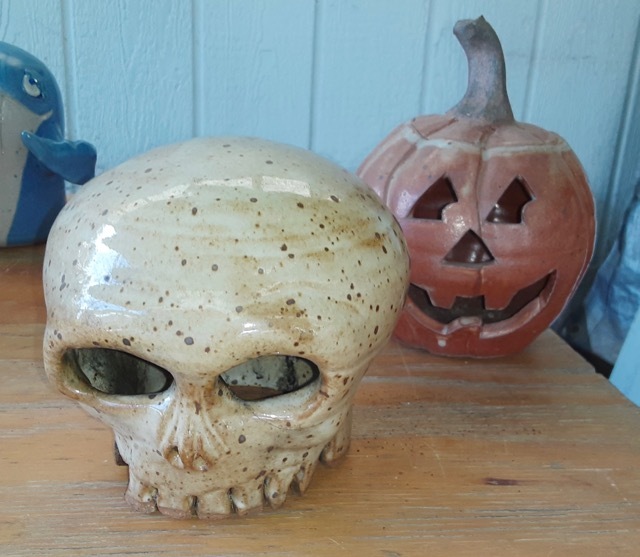
Retired bank patterns: blue whale, orca, beaver, bear; the last of a limited run of Halloween items; and a rather sweet elephant tea set, with baby elephant cream and sugar holders, and a reed handle that will need a serious amount of steaming to make it fit.

Some "face pots" I made at the UO Craft Center, well over 20 years ago.


A whole bunch of taper/candle holders I used to make and try to sell cheap, mostly because I could fit a zillion of them between bigger pots in the kiln. They've got scraps of stained glass melted into the well around the center post, blues and greens mostly. Also, a couple of the "bigger" pots themselves, a couple of jars between 18 and 24" high.


And a bunch of painted tile art: wall mounted paintings in the 4-6" range, and tiny pins and broaches, about an inch square. I kinda like the sunflower one. I may have to keep it for myself.
Everything old
Jan. 9th, 2020 11:01 am
A long, long time ago, in the before times--well, before Off Center Ceramics, anyway--I was working and teaching at the Craft Center for half-time pay, free firings, and all the recycled clay I could eat. I was married, Denise was job hunting, and I tried a lot of things to make up the difference between what I got paid, and what we needed to survive. (And no, eating clay wasn't really an option.)I took a bunch of custom and commemorative jobs: KLCC pledge premium mugs. Mugs for Marist High School and the Newman Center, the Environmental Law conference, 5-year Employee Appreciation mugs for the city of Eugene.
Some of these were one-shots; some continued for a while; I'm still doing City mugs, averaging two or three a year. A few, I had the good sense to turn down. (The FabTrol troll logo still haunts my nightmares.)
One of them literally changed my life. It was after we'd started Off Center, but were still struggling to make a go of it, wondering if I should be giving up and looking for a full-time job. The St. Vincent de Paul Society was planning their regional convention, and things weren't going well. The Portland organizing committee dropped the ball, and it looked like the whole thing might fall apart when the Eugene volunteers stepped up and took over.
One of the long-time Eugene stalwarts was a farmer, with strong ideas about food justice. He'd always thought the idea of poverty advocates meeting over a big banquet was weird and inappropriate, and lobbied hard for a simple bread and soup supper. And he got his way, almost. It wasn't the keynote dinner, as he'd wanted, but it was on the program. West Brothers, a local BBQ joint, provided the soup. The bread came from local bakeries. The table centerpieces were mason jars full of flowers tucked into orphan shoes from St. Vincent's thrift stores, and the cutting boards and bread knives were a motley assortment from the same source.
And the soup bowls were from me. They commissioned two hundred soup bowls, wholesale at ten bucks apiece, with the SVdP logo stamped into the bottom. Two thousand dollars, at a time when we desperately needed it, was a huge thing.
But even more important, they invited us to the dinner. Not just because it was a free meal, but because we came in first, and I got to sit and watch two hundred people excitedly going through stacks of my bowls, comparing their choices, each sure they'd found the best one. At a time when we were struggling at Market, wondering if anyone would ever like our work, it was an enormous encouragement.

Twenty-odd years later, I'm established. I know people like my work, because they buy it. They tell me how many pieces they have, how much their friends and family love it. I get emails and orders from all over. It's all I can do to keep up.
A few months back, I let slip to someone on that original organizing committee that I still had the SVdP stamp, and word got back to Terry McDonald, the head of our local St. Vincent's. He approached Denise at Clay Fest, said they'd really like another 200 bowls, no set deadline.
I really shouldn't. I have so much other work to make. But they were there for me when I needed them most, and I can't ever forget that. So I've dusted off the stamp, weighed out the recycled clay--some things never change--and started throwing. Fifty so far; 150 to go.
A brief paws
Dec. 5th, 2019 07:56 pmWe closed in September, took possession October, and I spent a good deal of the first winter tearing up carpet and building a studio: building a work table and ware rack, bringing in a wheel and mounting the extruder and slab roller. I bought a used electric kiln, eventually a used pug mill, covered walls with wipeable paneling or fireproof hardibacker.
By the next summer, I was happily throwing and bisquing at home, and Denise was cutting and soaking buckets of plant materials for paper in the carport, cooking down and blending pulp on the back porch.
Where we discovered that the property already had a tenant: a burly grey-and-white cat that seemed to be living under the pottery shed. She was skittish and wild, but Denise talked to her in a calming voice, just sitting nearby and working, all summer. It got so she'd almost get close enough to pet, before veering off again.
Came one rainy fall evening. I'd gone on a grocery run, and since the studio door opens on the kitchen, I was bringing in the bags through that way when big grey-and-white kitty strolled in between my legs, looked around at the dry, warm space and said, Okay, this is good. I can live with this.
We named her Pearl, partly after a cat from my childhood, partly for the perfect white tip on her otherwise grey tail. She lived in the studio for a couple of weeks, while we litter-box trained her and then was introduced to the rest of the cats and the rest of the house. She rapidly rose to the top of the feline hierarchy, and lived out the rest of her days a pampered indoor cat.
There's hardly a trace of her in the studio anymore, except for this: a soup bowl with her paw print as she daintily made her way across a ware board of newly thrown pots. We used it for years until another, more rambunctious cat knocked it off the table and broke it. I glued it back together and keep it in the studio in her memory.

I've not had a studio cat since. I strongly suspect the experience would be much more like you'd see in this video.
Voices from the past
Nov. 27th, 2019 10:23 pm
Sunday afternoon at Clayfolk, and a voice says, Is that Frank? Do you remember me? It's Amy Ruth!
And the thing is, I do. The voice is familiar, the face almost, and the name rings a vague bell. But I can't figure out from where.
And no wonder. Amy Ruth was one of our student employees at the UO Craft Center, when I was a resident potter there. Back around, oh, 1993. (Sadly, a year after co-resident Peter Meyer left, or we could have had a double reunion.) She's 44, now, married, with five kids, a 16-year-old daughter and stair-step boys. After some time in Anacortes, and years in Forest Grove, she missed the sunshine, so they moved back to Southern Oregon two years ago.
The boys were with their dad at Kids Clay, but I got to meet daughter Addie Rae. Amy picked out a woodpecker mug for her carpenter husband; Addie Rae spotted a raven mug for herself. And I snapped a pic, for here, and to send off to Diane at the Craft Center, assistant director then, now in charge of the whole shebang.
One of them is readily accessible, and holds work fresh from the kiln, glazed pots being held over for the next firing, a constantly revolving array of work-in-progress and work bound for home and sale. The other is tucked in an alcove, hard to move ware boards in and out of, and tends to just accumulate... stuff. It's like an attic, or the back of the hall closet. You never know what's in there, or how long it's been.
So I put on my dust mask, because the amount of air-born clay you can accumulate over time is frightening, got a sponge and a bucket, and had at it.
The first thing I discovered was I could tell how long it had been. I found blank inventory sheets dated 2001 on the top shelf, among other things, suggesting that the entire side had been little disturbed since I took over the space from Corey and Kelly back about then. I also found silkscreens and ink, and a box of Off Center Ceramics t-shirts from an ill-fated attempt to expand into the "I'm traveling and can't take back anything fragile" market. I think I only ever sold two, one rooster and one cat. This was a box of a couple dozen cats shirts, screen-printed, but without the hand-coloring that differentiated a yellow tiger from a brown-point siamese. They were also weirdly mottled in spots. Apparently, newsprint contains enough traces of bleach that it can take out the color of a yellow shirt where it touches.
I donated the silkscreens to Maude Kerns; they're restarting their printmaking classes this spring. The ink and fabric paints went in the dumpster, the shirts will mostly go to Goodwill, except for a few Denise kept back to wear. Anyone want one? I've got medium, large, and extra-large.
I also found a variety of broken bisque, test tiles, and old magazines, dumpster-bound. A pasta bowl with scarred rim, kept because it heroically gave its life to hold up the shelves when a kiln post failed. Some books that, after dusting, will come home to my studio collection. A couple of burnished, pit-fired pots from an earlier series of work than never really found an audience. And a bunch of small sculptures.

I used to teach hand building and sculpture, both at the UO Craft Center and later, at Club Mud. I didn't keep all of my demos, but I did keep some, which is how I wound up with:
1. A goose with a mustache, double chin and work boots. ("Self-portrait as an animal of your choice.")
2. A nude torso, self-portrait with bar of soap. ("Make a nontraditional gargoyle, modeled solid and and hollowed.")
3. This rather nice primitive ram sculpture, pit-fired. ("Seal two pinch pots together and build a hollow sculpture from them.)
Not sure what to do with all this stuff; I keep thinking I'll put the gargoyle on a downspout when I eventually build a kiln and its enclosure. For now, I've just cleaned everything off and consolidated them on a single shelf. I've still got half a dozen shelves to go through, and a few ideas about re-organizing the space to make it more accessible, possibly paint the raw wood. We did that on the front half a few years ago, and it really brightened up the space.
Maybe in another 20 years.